


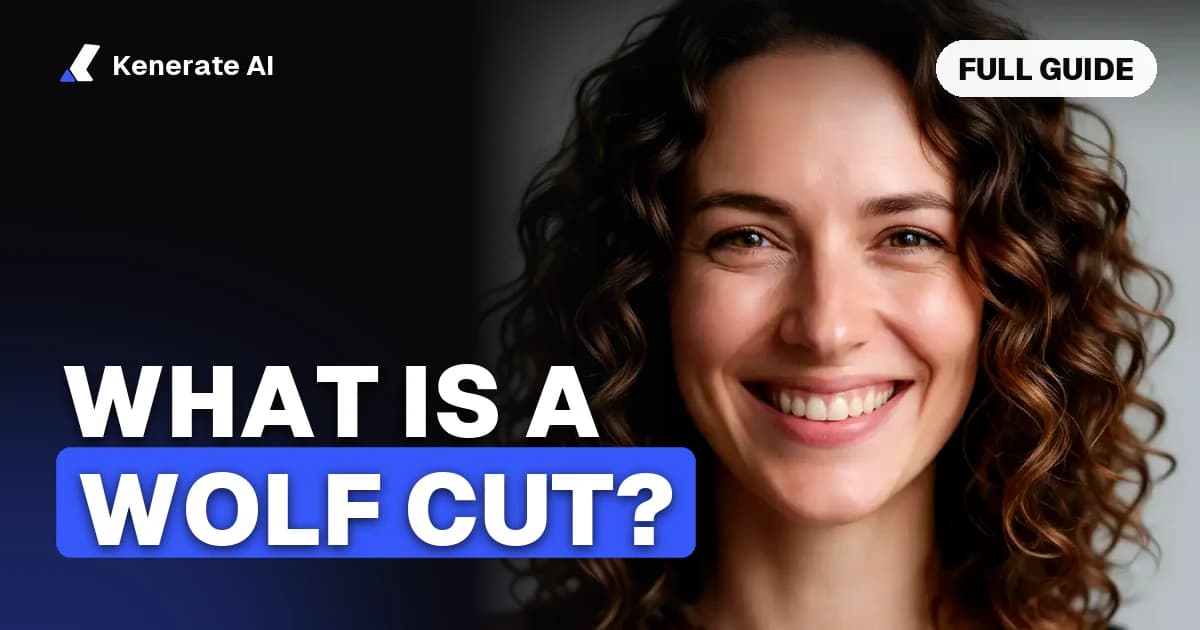
A wolf cut is a choppy, heavily layered haircut that crosses a '70s shag with an '80s mullet: short, lifted layers at the crown, longer and wispier lengths at the back, and usually a fringe or curtain bangs. It works on any gender and at most lengths from the chin down, and it is easiest on wavy, curly or thick hair. Straight and fine hair can wear it too, with softer layers and a little more styling.
Updated 5 November 2026.
This guide covers what the cut looks like, how it differs from a shag and a mullet, who it suits by hair type and face shape, what to say to your stylist, and how much upkeep to expect. If you already know you want the short version, our short wolf cut guide has ten chin-to-shoulder variations.
What is a wolf cut?
There is no official definition. A professionally trained stylist writing for Mane Addicts says the cut doesn't have an exact one, and that the result depends on how each stylist interprets it (Mane Addicts). The common description, used by TONI&GUY's Global Creative Director in Hello!, is a hybrid of the '70s shag and the '80s mullet (Hello!).
Most wolf cuts share four features:
- A short, lifted crown. Layers on top are cut short so the hair stands up and away from the head.
- Longer sides and back. The lengths stay long and are connected to the crown by layers, with no hard line between the two.
- A deliberate jump in length. Sections look a little disconnected, which gives the rough, choppy outline.
- A fringe that blends back. Curtain bangs or choppy bangs run toward the ears and melt into the crown layers.
The name is usually explained by the shape of a wolf's coat: shorter around the ears and eyes, and longer and thicker toward the neck, as Mane Addicts puts it.
What does a wolf haircut look like in pictures?
When you browse pictures of wolf cuts, check the silhouette rather than the styling. From the front you should see height at the crown, a fringe opening out to the cheekbones and a narrower shape toward the jaw. From the side you should see a step down from the short top to the longer back. From behind, the ends look wispy and uneven, not cut in a single straight line. If a photo shows smooth, even layers with no height, it is closer to a shag or a layered lob.
Is a werewolf cut the same as a wolf cut?
As far as we can find, yes. "Werewolf cut", "wolf hair cut", "wolf haircut" and "wolf cutting" are other ways people search for the same style. We found no stylist source that defines the werewolf cut as a separate haircut, so if you use that name at the salon, bring a photo to make sure you both mean the same thing.
Wolf cut vs shag vs mullet: what's the difference?
The three cuts sit on one scale, from soft to extreme. Mane Addicts even says there isn't much difference between a wolf cut and a shag once a stylist has put their own spin on it, so treat these as tendencies rather than rules.
| Shag | Wolf cut | Mullet | |
|---|---|---|---|
| Top | Soft, feathered layers | Short, choppy, lots of lift | Short |
| Sides | Layers hug the face | Longer, linked to the crown by layers | Short and tight around the ears |
| Back | Tapers gradually | Longer and wispy | Clearly long |
| Transition | Blended | Choppy, slightly disconnected | Abrupt |
| Overall feel | Soft, '70s | Wild, textured | Bold, high contrast |
Luxe Digital sums it up neatly: the wolf cut takes the mullet's length and the shag's choppy texture, while a true mullet keeps a sharp contrast between the short front and long back (Luxe Digital). A shag has balanced layers that taper gradually; a wolf cut has a sharper jump between sections (Luxe Digital).
A simple way to choose: if you want softness around your face, ask for a shag. If you want height on top and more edge, ask for a wolf cut. If you want the back to do the talking, ask for a mullet.
Where did the wolf cut come from?
Its exact origin is unclear. Wikipedia lists it as a variation of the shag that became popular in the 2020s, and cites a 2021 Glamour article calling it a new take on the shag (Wikipedia). Luxe Digital credits K-pop idols and TikTok with making it popular, and Hello! also points to TikTok. Many blogs say it started in South Korea, but we couldn't find a reliable source that proves it, so we're not stating that as fact.
The cut has stayed around in softer forms: Hello! was still writing about its comeback in October 2025.
Who does a wolf cut suit?
Hair type matters more than face shape, because the cut depends on your hair holding its texture. Your density and natural movement decide how much styling you will do each morning.
Which hair types work best?
| Hair type | How it behaves | What to ask for |
|---|---|---|
| Wavy | The easiest match; waves shape the layers on their own | Standard wolf cut, air-dry with salt spray |
| Curly | Curls give natural volume and separation | Dry or curl-by-curl cutting, crown layers left a little longer to allow for shrinkage |
| Straight | Layers lie flat without help | Crown volume cut in, plus texture spray or powder daily |
| Fine | Heavy chopping leaves ends thin | Soft, blended layers, no all-over thinning |
| Thick | Takes the shape well but can feel heavy | Internal texturising to remove bulk |
| Thinning | Choppy layers can add the look of volume | Shorter overall length, soft ends |
The cut also has a practical minimum. Luxe Digital reports John Frieda's guidance that hair should reach about chin length, because shorter hair has no room for the contrast between crown and lengths.
Which face shapes suit a wolf cut?
Hairstyle guides don't fully agree here. Luxe Digital, citing Forte Series, lists oval, round and diamond faces as natural fits, and adds ways to adapt it for others. Use the table as a starting point; if you are unsure of your shape, our guide on how to find your face shape takes five minutes.
| Face shape | How to adapt the cut |
|---|---|
| Oval | Almost any version works |
| Round | Keep height at the crown and vertical layers; avoid width at the cheeks |
| Square | Wispy layers and textured ends to soften the jaw |
| Diamond | Curtain bangs to balance the cheekbones |
| Long | Forward-falling, face-framing layers; go easy on crown height |
| Heart | Fringe and layers that add some width near the jaw |
Does the wolf cut work for men?
Yes. Men's versions run from short and tidy to long and choppy. Sides are often shortened with a taper or a low or high fade, while the crown stays textured and the neckline stays long. Wavy and curly hair again need the least work.
What should you ask your stylist for?
Because "wolf cut" means different things to different stylists, say the name and then describe the parts. Luxe Digital's advice and the points below come down to the same thing: be specific.
- Show front, side and back photos, ideally on hair like yours.
- Give the longest length: "I want the back to sit at my collarbone."
- Say how much to keep on top, in inches or by pointing at your face.
- Describe the crown: "Short, choppy layers for volume."
- Protect the back: ask them not to tidy the neckline away, or say "not too mullet" for a subtle version.
- Pick a fringe: curtain bangs, wispy bangs or face-framing pieces only.
- Agree on the finish: textured ends or softer ones. If your hair frizzes easily, ask how they plan to cut the texture in.
- Ask how it will air-dry, since that's how you'll probably wear it most days.
A sentence you can read out: "A wolf cut with the longest layers at my collarbone, short choppy layers at the crown, curtain bangs blended back into the sides, and a wispy back, textured but not thinned out."
If you've saved a photo and don't know what the style is called, how to identify a hairstyle from a photo can help you name it.
How much maintenance does a wolf cut need?
It takes little daily effort but regular trims. Both Hello! and Luxe Digital recommend a trim every six to eight weeks to keep the shape. Fringes usually need a quick tidy in between. Hair grows roughly a centimetre a month, so after two months the crown layers have noticeably dropped and the shape starts to soften.
How do you style a wolf cut?
For a quick everyday finish, based on the routines in Luxe Digital and Hello!:
- Work sea salt spray or mousse into damp hair.
- Rough-dry with your fingers, or scrunch if you have waves. Lift the crown as you go.
- Shape the fringe with a small round brush, or twist the front pieces away from your face.
- Finish with a little clay or styling cream on the ends. Texture powder at the roots helps hold the crown up.
Hello! also suggests a weekly deep conditioner and air-drying when you can, since textured ends show dryness quickly.
Can you grow out a wolf cut?
Yes. As it grows, it tends to soften into a shag and then a long layered cut, provided your stylist gradually blends the crown layers into the lengths. The awkward stage is when the crown reaches the middle layers, and a light trim at that point helps. Going from a mullet-heavy version takes longer than a soft one.
Can you try a wolf cut before you cut your hair?
Yes. You can preview it on a photo of yourself with an AI hairstyle changer, which redraws the hair while keeping your face and background. It runs in the browser, with no app and no watermark. Treat the result as a preview, not a guarantee: AI shows a styled version, not how your hair will air-dry on a Tuesday.
- Sign up. A new Kenerate AI account gets 25 free credits.
- Open the Image Studio and upload a clear, front-facing photo with your hair visible.
- Choose a model from the table below.
- Paste a detailed prompt: "Give this person a wolf cut: collarbone-length, short choppy layers at the crown, curtain bangs blended into the sides and a wispy back. Keep their face, expression, skin, clothing, background and lighting exactly the same."
- Change one thing per edit, such as the fringe, then the length, then the texture.
- Save the one you like and show it to your stylist with your reference photos.
Only edit photos of yourself, or of someone who has agreed to it.
Prices come from Kenerate's credit calculator as of 5 November 2026.
| Model | Plan | Credits per edit | Good for |
|---|---|---|---|
| Flux 2 Dev | Free plan | 3 | Quick ideas; about 8 try-ons from your free credits |
| Qwen Image 3.0 | Free plan | 9.9 with one photo | Free-plan alternative; about 2 try-ons |
| Seedream 5.0 Pro | Credit pack | 13.5 (1K), 27 (2K) | Kept faces identical across nine hairstyles in our tests |
| Nano Banana 2.1 | Credit pack | 21 (1K), 31.5 (2K) | Up to 14 reference images |
Credit packs are one-time purchases and the credits don't expire; see pricing. Planning a new shade as well? The AI hair color changer recolours your photo and keeps the cut.
Should you get a wolf cut?
Get one if you like a lived-in, textured look, your hair reaches at least your chin and you're happy to book a trim every couple of months. Choose a softer shag-leaning version if your hair is fine or you want an easy grow-out. Skip it if you prefer sleek, one-length hair, because the choppy shape won't sit smooth. Still unsure? Try it on your own photo first, then take that picture to the salon.
Sources: Hello!: The wolf cut is back for autumn · Luxe Digital: Wolf cut for men · Luxe Digital: Shag haircut · Mane Addicts: Wolf cut vs shag cut · Mane Addicts: Mullets, shullets and wolf cuts · Wikipedia: Shag (haircut)