

Biology · cell structure
Plant cell 3D model with labels
Look inside a cutaway plant cell, learn what every part does, and use it for a school project.
By the Kenerate AI teamUpdated 2 min read
See the animal cell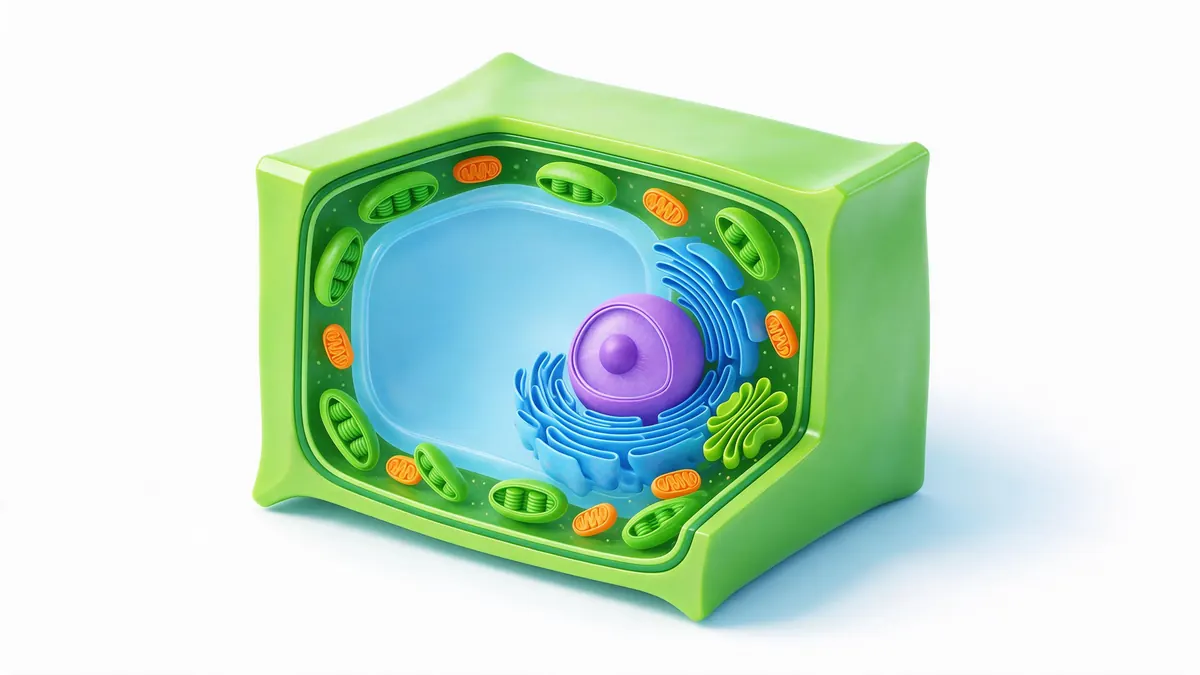
Quick answer
Updated
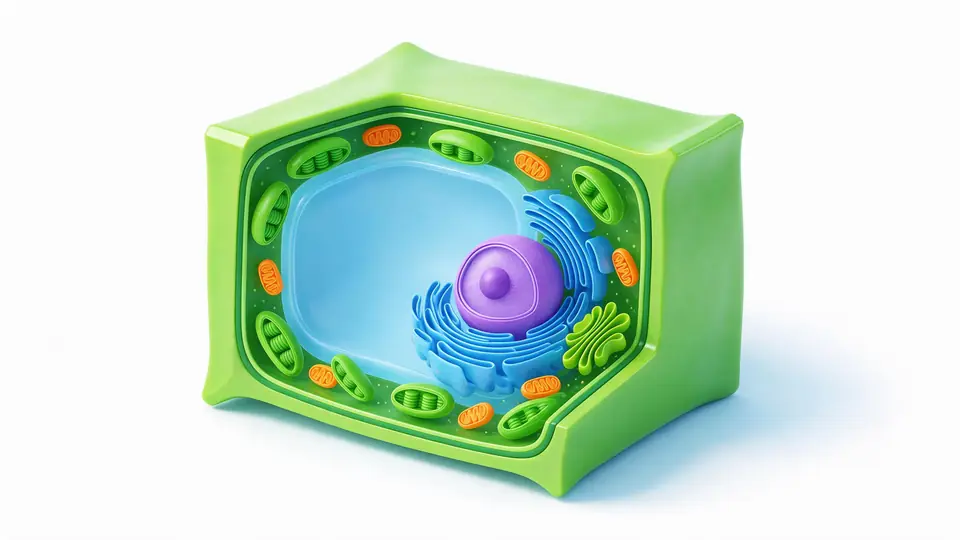
A plant cell is a eukaryotic cell with three structures animal cells lack: a rigid cell wall made mainly of cellulose, chloroplasts for photosynthesis and a large central vacuole that keeps the cell firm. It also has a nucleus, mitochondria, ER, Golgi apparatus and ribosomes. The illustration below is simplified and not to scale.
Key facts
- Unique to plant cells
- Cell wall · chloroplasts · large central vacuole
- Shared with animal cells
- Nucleus, mitochondria, ER, Golgi, ribosomes, membrane
- Energy
- Chloroplasts (photosynthesis) and mitochondria (respiration)
- Illustration
- Simplified, not to scale
On this page
Plant cell 3D model
Plant cell parts, labeled
| Part | What it is | What it does |
|---|---|---|
| Cell wall | A rigid layer outside the membrane, mostly cellulose [1] | Gives the cell its shape and protects it |
| Central vacuole | A large fluid-filled sac [1] | Stores water and substances; keeps the cell firm (turgor) |
| Chloroplasts | Organelles containing chlorophyll [1] | Carry out photosynthesis — light to sugar |
| Nucleus | Holds the cell's DNA, with a nucleolus [1] | Controls the cell; the nucleolus makes ribosome parts |
| Mitochondria | Double-membrane organelles [1] | Release energy from sugar (ATP) |
| Endoplasmic reticulum | Network of membranes [1] | Makes proteins (rough ER) and lipids (smooth ER) |
Plant cell vs animal cell
| Plant cell | Animal cell | |
|---|---|---|
| Cell wall | Yes (cellulose) | No |
| Chloroplasts | Yes | No |
| Vacuole | One large central vacuole | Small vacuoles, if any |
| Centrioles | Usually absent | Present |
| Shape | Fixed, often boxy | Flexible, rounded |
How to make a plant cell 3D model for a school project
- Build it from clay, a foam (styrofoam) block or a cardboard box — one colour per organelle, with a big clear bag or balloon for the central vacuole — or print one.
- Make a 3D model with AI in the Kenerate 3D Studio from a short description, then print it.
- Add labels with small flags or a printed key.
- Mention that it's simplified: real cells are microscopic and contain far more of each organelle.
How it works
How it works in the app
Step 1
Choose text, photo or multi-view
Open 3D Studio and pick how to start: describe an object, upload a photo, or add several views.
Step 2
Pick a 3D engine
Open the model card to choose the engine and version that fits your object.
Step 3
Describe the object
Write one object on a plain background, then set textures, PBR materials and quality.
Step 4
Click Build 3D model
Press Build 3D model to start — the textured model appears in your gallery.
See it in the app

Open 3D Studio and pick how to start: describe an object, upload a photo, or add several views.


FAQ
Plant cell 3D model: questions
What are the main parts of a plant cell?
Cell wall, cell membrane, cytoplasm, nucleus, chloroplasts, central vacuole, mitochondria, endoplasmic reticulum, Golgi apparatus and ribosomes.
Link to this answerWhat three things do plant cells have that animal cells don't?
A cell wall, chloroplasts and a large central vacuole.
Link to this answerHow do I make a 3D model of a plant cell?
Build one from clay or craft materials, or make one in a 3D app or with AI and print it.
Link to this answerWhat should the labels on a plant cell 3D model show?
Label the cell wall, cell membrane, cytoplasm, nucleus, chloroplasts, central vacuole, mitochondria, endoplasmic reticulum, Golgi apparatus and ribosomes, each with a one-line job — the parts table above gives you the wording. Point out the three parts animal cells lack: the cell wall, chloroplasts and large vacuole.
Link to this answerCan I 3D print a cell model?
Yes — make one in a 3D app or with AI, export STL and print it in PLA; paint each organelle a different colour.
Link to this answerIs this illustration accurate?
It shows the main structures and roughly where they sit, simplified and not to scale.
Link to this answerSee the animal cell
Compare it with the animal cell 3D model — or make your own model with AI.