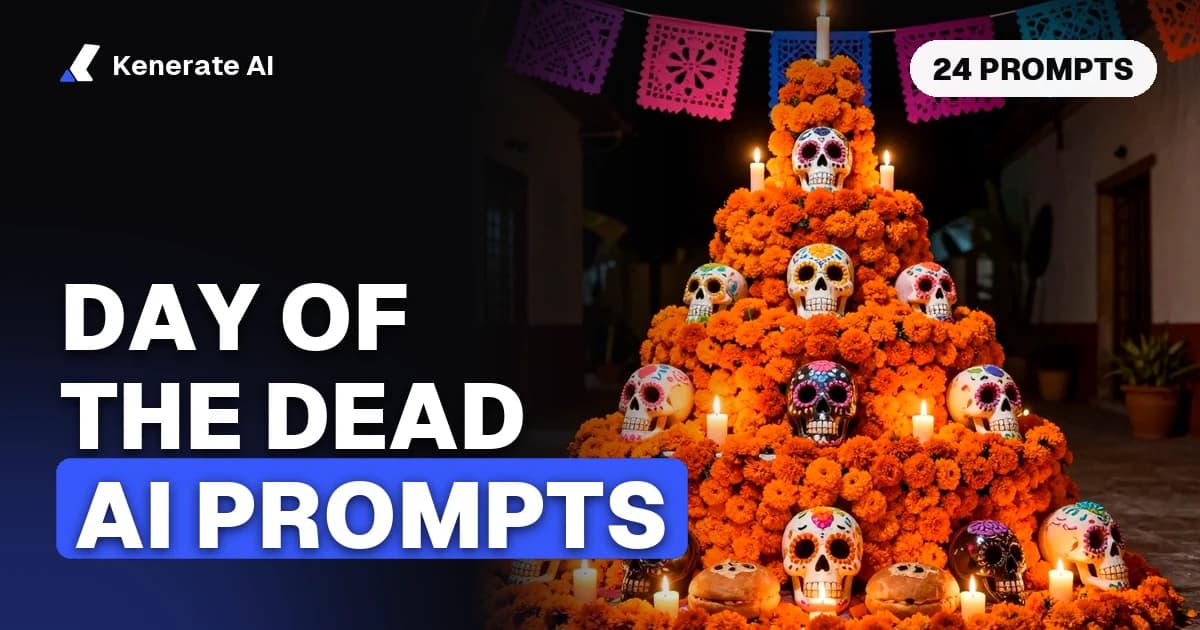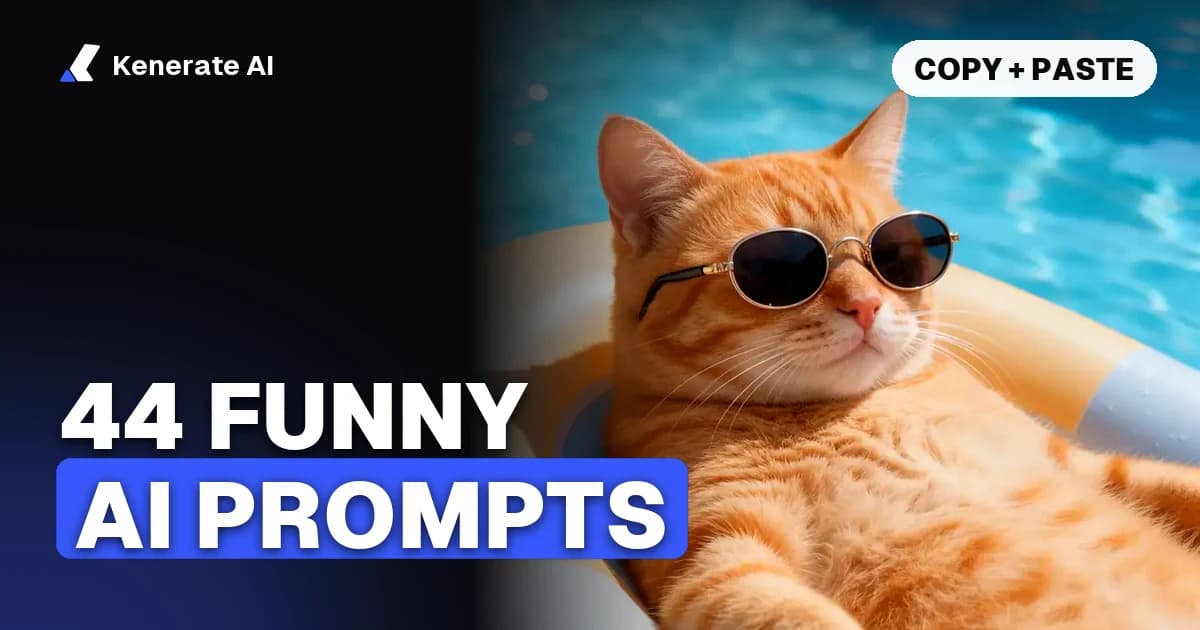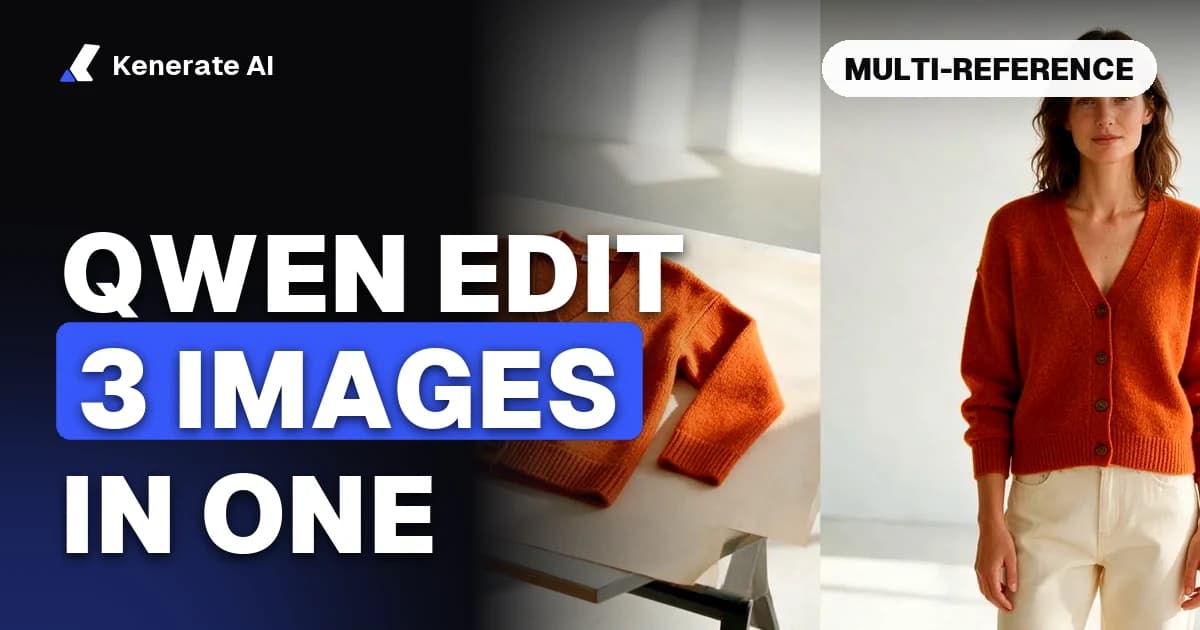
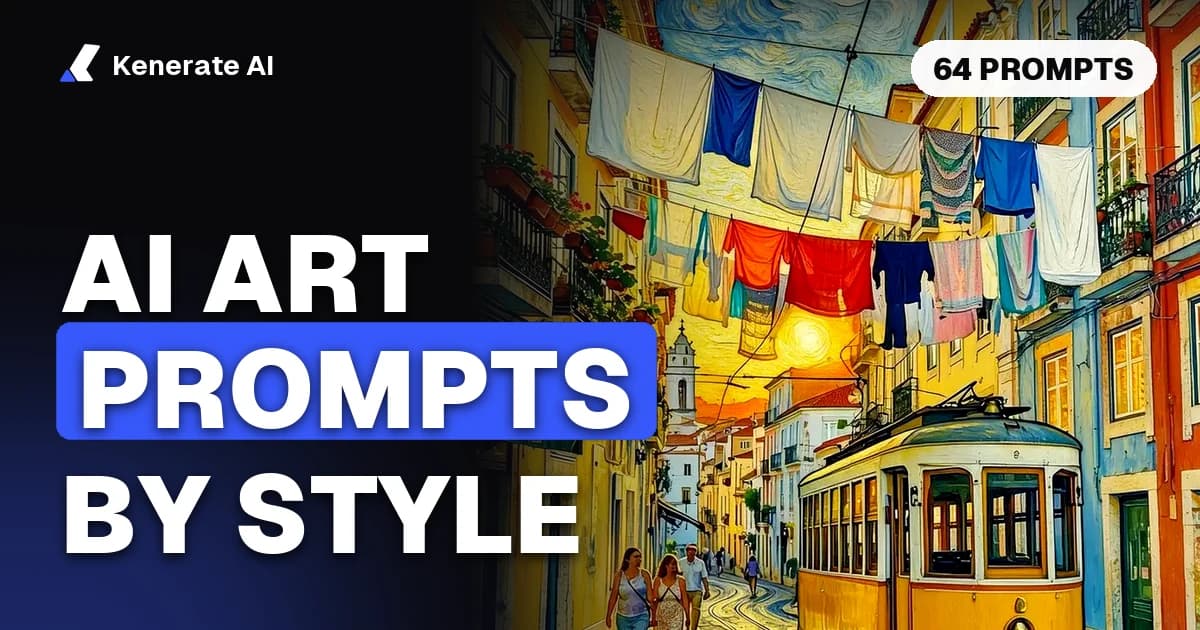
A good AI art prompt names six things: the subject, the style, the medium, the lighting, the composition and the camera or viewpoint. Most weak prompts only name the subject. "A fox" gives you a generic stock image. "A red fox curled asleep under a snowy pine, Japanese ukiyo-e woodblock print, flat colors and fine outlines, cold blue dawn light, wide view with lots of empty sky" gives you a picture. Below is that anatomy, 64 copy-paste prompts across art styles (oil, watercolor, ukiyo-e, pop art, steampunk, vaporwave, origami, stained glass and more), and which Kenerate model to use for each style. Checked October 23, 2026.
Each prompt here is written to be read as a sentence, not a pile of tags, since current image models (GPT Image, Seedream, Nano Banana, FLUX.2) follow natural language best. For photo-style prompt sets, such as headshots or product shots, see Kenerate's topic prompt pages like cinematic movie still prompts. This post is about art styles.
What goes into an AI art prompt?
Google's image prompt guide for Imagen breaks a prompt into subject, context and style, then adds camera, lens and lighting modifiers. OpenAI's GPT Image prompting guide gives the same advice in different words: name the materials, textures and visual medium. Put together, that's six parts:
| Part | What it controls | Words that work |
|---|---|---|
| Subject | Who or what, doing what | "an old lighthouse keeper reading by lamplight", "a koi pond after rain" |
| Style | The art movement or look | "ukiyo-e", "art nouveau", "pop art", "vaporwave", "steampunk" |
| Medium | What it's made of | "oil on canvas, thick impasto", "watercolor on cold-press paper", "stained glass", "folded paper" |
| Lighting | Mood and depth | "golden hour", "soft overcast light", "rim light", "candlelight", "neon glow" |
| Composition | Layout and framing | "centered", "rule of thirds", "wide view with empty sky", "symmetrical", "close-up" |
| Camera / viewpoint | Angle and lens feel | "low angle", "bird's-eye view", "isometric", "macro", "35mm", "fisheye" |
Two more help a lot: a color palette ("teal and burnt orange", "muted earth tones") and a mood ("quiet", "eerie", "playful"). You don't need all eight every time. Start with subject, style and medium, then add the rest only where the result looks generic.
How do you write an AI art prompt step by step?
- Write the subject as one clear sentence. One main subject and one action. "A heron standing in a misty marsh" beats "birds, water, nature, fog".
- Pick one style, not five. "Watercolor anime cyberpunk baroque" averages into mush. One movement plus one medium is usually enough.
- Name the medium and its texture. "Thick impasto oil paint", "visible paper grain", "lead lines between glass panes". Texture words are what make art look made rather than rendered.
- Set the light. Light sets the mood more than anything else in the prompt.
- Frame it. Close-up, wide, top-down, centered. Set the aspect ratio in the tool's settings rather than only writing it in the prompt.
- Say what to leave out, in plain words. Most current models, including every model in the table further down, don't have a separate negative-prompt field on Kenerate. Write "no text, no border, no signature" in the prompt itself.
- Change one word at a time. Swap "watercolor" for "gouache" and compare. Rewriting everything at once makes it hard to see what helped.
64 AI art prompts you can copy
Swap the subject and keep the style words; that's how you make a series. Each prompt names a style and a medium.
Painting (10)
- Oil, impasto: "A fishing harbor at sunset, oil painting on canvas with thick impasto brushstrokes, warm oranges against deep blue water, loose and expressive."
- Oil, old master: "Still life of pears, a pewter jug and a lemon on a dark wooden table, Dutch Golden Age oil painting, single window light, deep shadows, varnished glow."
- Impressionist: "A crowded Paris café terrace in spring rain, impressionist oil painting, broken dabs of color, reflections on wet cobblestones, soft diffused light."
- Watercolor, loose: "A heron standing in a misty marsh, loose watercolor on cold-press paper, soft wet-on-wet washes, lots of white paper showing, muted greens and greys."
- Watercolor, botanical: "Botanical watercolor study of a blooming peony with leaves and a bud, fine detail, labelled in small pencil handwriting, cream paper, plain background."
- Gouache: "A cozy mountain cabin in autumn, flat gouache illustration, matte opaque colors, simple shapes, ochre and deep green palette, children's book feel."
- Ink wash (sumi-e): "Bamboo stalks bending in the wind, Japanese sumi-e ink wash painting, expressive black brushstrokes, lots of empty rice-paper space, a small red seal stamp."
- Acrylic, bold: "A jazz trumpeter mid-solo, bold acrylic painting with palette-knife texture, electric blues and hot pinks, dramatic spotlight."
- Pastel: "A field of lavender at dusk, soft chalk pastel drawing on toned paper, blended purples and peach sky, visible paper tooth."
- Fresco: "Angels and clouds on a curved chapel ceiling, Renaissance fresco style, chalky faded pigments, fine cracks in the plaster, viewed from below."
Prints and graphic art (10)
- Ukiyo-e: "A red fox curled asleep under a snowy pine, Japanese ukiyo-e woodblock print, flat colors, fine black outlines, cold blue dawn, wide view with empty sky."
- Ukiyo-e, waves: "A small fishing boat in towering stylised waves with Mount Fuji far behind, ukiyo-e woodblock print, Prussian blue and cream, visible wood grain."
- Pop art: "A woman's face with a tear, holding a phone, 1960s pop art comic panel, bold black outlines, Ben-Day dots, primary colors, speech bubble saying 'NO SIGNAL'."
- Pop art, product: "A soup can repeated in a 3×3 grid, each in different bright colors, 1960s pop art screen print look, flat ink, slight misregistration."
- Risograph: "A cyclist crossing a city bridge, two-color risograph print in fluorescent pink and teal, grainy texture, slight misregistration, off-white paper."
- Linocut: "A crow on a fence post at dusk, black and white linocut print, bold carved lines, rough ink texture, a single orange moon."
- Art deco poster: "A streamlined 1930s ocean liner at night, art deco travel poster, geometric sun rays, gold and navy, the text 'ATLANTIC LINE' in deco lettering."
- Art nouveau: "A woman with flowing hair surrounded by irises, art nouveau poster style, ornate curved borders, soft gold and sage green, decorative lettering 'SPRING'."
- Bauhaus: "Abstract composition of circles, squares and a single diagonal line, Bauhaus poster style, red, yellow, blue and black on cream, clean geometry."
- Engraving: "A lighthouse on a rocky coast in a storm, 19th-century copperplate engraving, fine cross-hatching, black ink on aged paper."
Retro and aesthetic styles (10)
- Vaporwave: "A marble Greek bust in front of a pink and cyan sunset grid, palm trees, VHS scan lines, vaporwave aesthetic, dreamy 1990s computer graphics."
- Vaporwave, mall: "An empty 1990s shopping mall with a fountain and palm trees, pastel pink and teal, soft haze, vaporwave aesthetic, wide view."
- Synthwave: "A sports car driving toward a giant neon sun on a glowing grid highway, synthwave style, magenta and purple, chrome reflections."
- Steampunk: "A brass airship docking at a Victorian clock tower, steampunk illustration, copper pipes, gears and rivets, smoky amber sky, detailed."
- Steampunk, portrait: "An inventor in a leather apron with brass goggles, surrounded by ticking gears, steampunk oil painting, warm lamplight, rich browns and gold."
- Cyberpunk: "A rainy alley lit by neon signs and holograms, cyberpunk digital painting, reflections in puddles, cyan and magenta, a lone figure with an umbrella."
- Solarpunk: "A green city with rooftop gardens, wind turbines and glass trams, solarpunk illustration, bright daylight, hopeful mood, clean lines."
- 1950s retro-futurism: "A family flying car parked outside a dome house, 1950s retro-futurist magazine illustration, pastel colors, gouache texture, optimistic mood."
- Y2K chrome: "Chrome bubble lettering spelling 'HELLO' floating over an iridescent background, Y2K aesthetic, glossy reflections, holographic stars."
- Psychedelic 1960s: "A melting sunflower field under a swirling sky, 1960s psychedelic concert poster style, wavy lettering 'SUMMER SOUND', orange, purple and lime."
Craft and material art (10)
- Origami: "A crane taking off from a pond, made entirely of folded origami paper, crisp creases, soft studio light, pastel paper colors, shallow depth of field."
- Origami, diorama: "A tiny origami village with paper houses, trees and a river, papercraft diorama, top-down three-quarter view, soft daylight."
- Stained glass: "A peacock with its tail spread, stained glass window, bold black lead lines, jewel-tone glass, sunlight shining through, Gothic arch frame."
- Stained glass, landscape: "Rolling hills at sunrise, art nouveau stained glass panel, amber, rose and emerald glass, curved lead lines."
- Mosaic: "An octopus on a seabed, ancient Roman mosaic of small stone tiles, terracotta, ochre and blue, visible grout lines."
- Embroidery: "A bouquet of wildflowers, hand embroidery on linen in an embroidery hoop, satin and French-knot stitches, close-up, soft light."
- Paper cut layers: "A forest at night with a full moon, layered paper-cut art, five depth layers in shades of blue, soft shadows between layers."
- Claymation: "A grumpy cat chef stirring a pot, claymation style, plasticine texture with fingerprints, warm miniature-set lighting."
- Wood carving: "An owl perched on a branch, hand-carved wooden relief, visible chisel marks, walnut wood grain, side light."
- Knitted: "A tiny knitted wool dinosaur on a windowsill, cozy yarn texture, soft morning light, macro close-up."
Digital, 3D and game art (10)
- Pixel art: "A cozy bakery storefront at night, 16-bit pixel art, limited palette, warm window glow, falling snow, side view."
- Pixel art, sprite: "A knight character sprite sheet with idle, walk and attack poses, 32×32 pixel art, plain flat background."
- Isometric: "A tiny isometric island with a lighthouse, a cottage and a dock, 3D isometric illustration, pastel colors, soft shadows."
- Low poly: "A fox in a low-poly autumn forest, faceted 3D shapes, flat shading, orange and teal, clean background."
- Voxel: "A small voxel castle on a floating rock, cube-based 3D art, bright colors, waterfall pouring off the edge."
- 3D clay render: "A smiling cloud character holding an umbrella, soft 3D clay render, matte pastel materials, studio lighting."
- Concept art: "A desert city built inside a giant canyon, fantasy concept art, matte painting, tiny figures for scale, dusty golden light."
- Game splash art: "A sorceress casting a spell of green fire on a cliff edge, fantasy game splash art, dynamic pose, dramatic rim light."
- Holographic: "A jellyfish made of iridescent holographic film floating in black space, glowing edges, rainbow reflections."
- Glitch art: "A classical portrait bust split by RGB glitch bands and pixel sorting, digital glitch art, black background."
Illustration and drawing (8)
- Children's book: "A small bear sharing honey with a rabbit under a big oak tree, children's book illustration, soft colored pencil and watercolor, gentle and warm."
- Anime background: "A quiet country train station in summer, 1990s anime background painting, towering cumulus clouds, saturated blue sky, painterly detail."
- Comic book: "A masked hero landing on a rooftop at night, American comic book style, bold inks, halftone shading, dramatic angle from below."
- Line art: "A cat sleeping on a stack of books, single continuous line drawing, black ink on white, minimal."
- Charcoal: "An old fisherman's hands mending a net, charcoal drawing, strong contrast, smudged shadows, textured paper."
- Tattoo flash: "A swallow carrying a banner that reads 'HOME', traditional tattoo flash style, bold outlines, red, green and yellow, cream paper."
- Chalk art: "A giant sea turtle swimming across a sidewalk, colorful street chalk art, rough chalk texture, viewed from above."
- Architectural sketch: "A modern glass house on a hillside, loose architectural pen sketch with marker shading, white background."
Surreal, fantasy and abstract (6)
- Surrealism: "A staircase rising out of a calm sea into the clouds, a single door at the top, surrealist oil painting, soft dreamlike light."
- Magical realism: "A whale swimming slowly through a misty pine forest at dawn, magical realism painting, muted greens, quiet mood."
- Dark fantasy: "A ruined cathedral overgrown with glowing blue flowers, dark fantasy digital painting, moonlight through broken windows."
- Cosmic: "A lone astronaut sitting on a crescent moon fishing for stars, whimsical cosmic illustration, deep purple sky, gold accents."
- Abstract expressionism: "Abstract expressionist painting of a thunderstorm, energetic sweeping strokes, splatters, deep blue, black and flashes of yellow."
- Minimalist: "A single red balloon floating over a vast white desert, minimalist art, lots of negative space, soft shadow."
Want more prompts by topic? Kenerate has prompt pages for digital concept art and cinematic movie stills, and the prompt enhancer turns a short idea into a detailed prompt.
Which AI model is best for which art style?
No single model wins every style. Here's how the models on Kenerate compare, with features and credits taken from Kenerate's model config on October 23, 2026.
| Model | Best for | References | Credits per image |
|---|---|---|---|
| Seedream 5.0 Pro | Illustration, anime, painterly styles, all-round art | Up to 10 | 13.5 (1K / 1.5K) · 27 (2K) |
| Recraft 20B | Built-in style presets: watercolor, pixel art, kawaii, voxel, engraving, hand-drawn, 80s, psychedelic and more (26 in total) | None | 6.6 |
| Recraft V4.1 | Posters, typography, design-ready art | None | 12 |
| Krea 2 Large | Aesthetic, highly detailed art, matching a style from your images | Up to 10 style references | 18 (19.5 with references) |
| GPT Image 2.5 Sunburst | Art with exact text (posters, tattoo flash banners), complex instructions | Up to 16 | From 3 (low) · 7.2 (medium, 1K) |
| Nano Banana 2.1 | Keeping one character or object the same across a series | Up to 14 | 21 (1K) · 31.5 (2K) · 42 (4K) |
| FLUX.2 Dev | Cheap drafts, testing style words | Up to 3 | 3 (free plan) |
| Qwen Image 3.0 | All-round art, English and Chinese prompts | Up to 3 | 9 (free plan) |
A practical workflow:
- Test your style words on a cheap model first: FLUX.2 Dev or Qwen Image 3.0, both on the free plan, in the AI art generator.
- Once the style reads right, run the final on Seedream 5.0 Pro or Krea 2 Large for painting and illustration, or GPT Image 2.5 if the art includes text.
- For a series, add your best image as a style reference so the next ones match.
New accounts get 25 sign-up credits to try the free-plan models.
Can you name an artist in an AI art prompt?
You can describe art movements, periods and techniques, and those prompts usually work better anyway: "post-impressionist, swirling brushstrokes, thick paint" tells the model what to draw. Picsart's AI art prompt guide gives the same advice: name movements rather than living artists. Copying a living artist's recognizable style to sell work in their name is unfair to them, and some platforms block it. Movement names like ukiyo-e, art nouveau, Bauhaus and pop art describe shared visual languages that anyone can work in.
Why does my AI art look generic, and how do you fix it?
| Problem | Likely cause | Fix |
|---|---|---|
| Looks like a stock render | Only a subject, no medium | Add a medium and texture: "oil on canvas, thick impasto" |
| Muddy, confused style | Too many styles stacked | Keep one movement plus one medium |
| Flat and lifeless | No lighting | Add a light source and time: "low golden sun from the left" |
| Subject too small or cropped | No framing | Add "close-up", "centered" or "wide view", and set the aspect ratio |
| Random text or a signature appears | Model filling space | Add "no text, no signature, no border" |
| Series doesn't match | Style drifts between prompts | Reuse the exact style block and add a style reference image |
Can you turn a photo into AI art?
Yes. Upload the photo and describe only the new style plus what must stay: "Turn this photo into a Japanese ukiyo-e woodblock print with flat colors and fine outlines. Keep the composition and subject." Most prompts above work as restyle prompts if you replace the subject with "this photo". Kenerate's photo to painting and AI style transfer tools are set up for this. Only restyle photos you took or have permission to use.
Frequently asked questions
What is a good AI art prompt?
A good AI art prompt names the subject, the style, the medium, the lighting, the composition and the viewpoint in one or two clear sentences. For example: "A heron in a misty marsh, loose watercolor on cold-press paper, soft grey morning light, wide view with empty space at the top."
How long should an AI art prompt be?
Usually 20 to 60 words. Short prompts leave the model to guess, while very long ones start to drop details. Start with subject, style and medium, then add lighting and framing only where the result looks generic.
What are the best AI art styles to try?
Styles with strong, recognisable visual rules work best: ukiyo-e, pop art, art nouveau, stained glass, pixel art, watercolor, oil impasto, vaporwave, steampunk and origami. They give the model concrete things to draw, such as outlines, dots, lead lines, paper folds or brushstrokes.
Which AI model is best for AI art?
For painting and illustration, Seedream 5.0 Pro and Krea 2 Large are strong choices on Kenerate. Recraft 20B has 26 built-in style presets. GPT Image 2.5 is best when the art includes text. FLUX.2 Dev (3 credits) and Qwen Image 3.0 are on the free plan and good for testing style words.
Do negative prompts work for AI art?
Many current models, including GPT Image, Seedream, Nano Banana and FLUX.2 on Kenerate, have no separate negative-prompt field. Write the exclusions in plain words inside the prompt: "no text, no signature, no border, no extra people".
How do I keep the same style across a series of AI images?
Keep the style part of the prompt word-for-word identical and only change the subject. Then add your best image as a style reference: Krea 2 Large takes up to 10 style references, Seedream 5.0 Pro up to 10, Nano Banana 2.1 up to 14.
Can I use artist names in AI art prompts?
It's better to describe the movement and technique than to name a living artist. "Art nouveau poster, ornate curved borders, flowing hair" is clearer to the model and fairer to working artists than copying one person's style.
Can I make AI art for free?
Yes. New Kenerate accounts get 25 sign-up credits, and the free plan includes FLUX.2 Dev (3 credits per image) and Qwen Image 3.0 (9 credits per image), which is enough to test several of the prompts above.
Sources
- Google Cloud: Prompt and image attribute guide (Vertex AI / Imagen)
- OpenAI Cookbook: GPT Image Generation Models Prompting Guide
- Tate: Pop art, art term
- Picsart Blog: AI art prompts: 30 ideas to spark original artwork (updated July 7, 2026)