

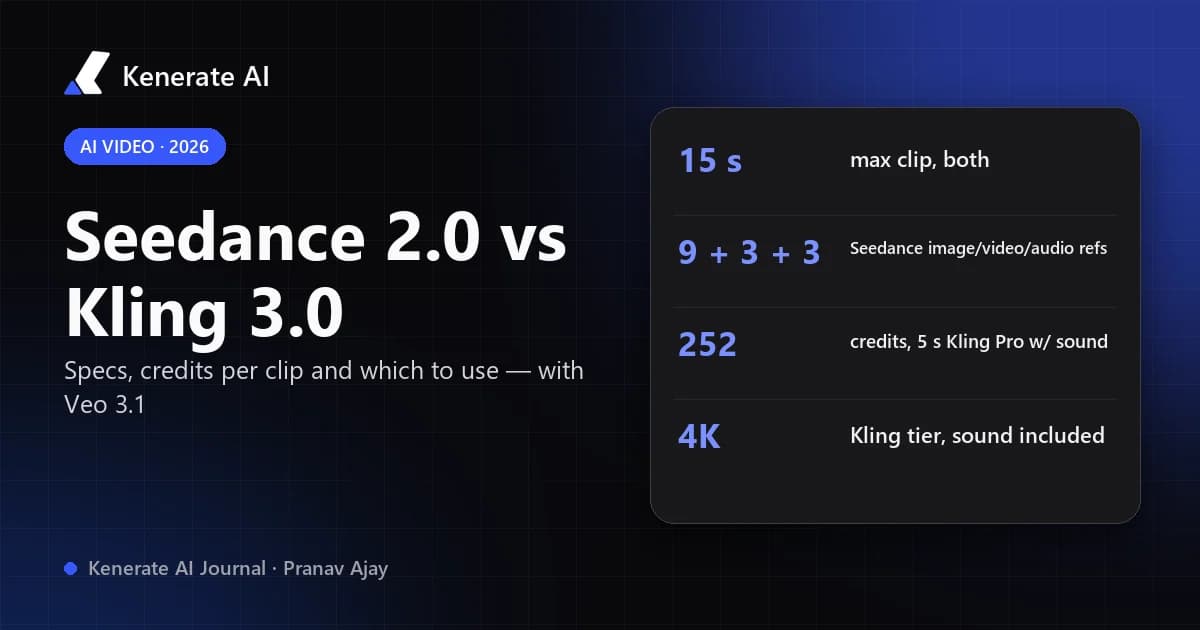
Seedance 2.0 is the better pick when you need control: it takes up to 9 images, 3 video clips and 3 audio clips as references and keeps characters and products consistent across shots. Kling 3.0 is the better pick when you need cheaper, cleaner single clips with strong motion and an optional 4K tier. Veo 3.1 sits above both for polished 8-second clips with dialogue, at a much higher price per second.
This comparison is current as of 18 October 2026. Specs come from ByteDance's Seedance 2.0 paper, Kuaishou's Kling 3.0 launch coverage and Google's Veo documentation; prices are the credit rates Kenerate AI charges today for each model, so you can compare like for like in one place.
What are Seedance 2.0 and Kling 3.0?
Seedance 2.0 is ByteDance's audio-video model. According to the ByteDance Seed team, it was officially released in China in early February 2026 and accepts four kinds of input — text, image, audio and video — with up to 3 video clips, 9 images and 3 audio clips as references. It generates 4–15 second clips with sound in one pass, and there is a lower-latency Seedance 2.0 Fast version.
Kling 3.0 (officially Kling VIDEO 3.0) is Kuaishou's model, announced on 5 February 2026. CineD's launch report describes native 2K/4K output generated during diffusion (not upscaled), multi-shot sequences of up to 15 seconds from a single prompt, and synchronised audio. It ships as Standard, Pro and 4K tiers.
The two launched within days of each other, which is why "Seedance 2.0 vs Kling 3.0" became one of the most searched AI video match-ups of 2026.
How do Seedance 2.0, Kling 3.0 and Veo 3.1 compare on specs?
Here is the side-by-side as the three models run on Kenerate AI (from our model configuration, 18 October 2026), with Veo 3.1 added as the third column people usually ask about.
| Seedance 2.0 | Kling 3.0 (Std / Pro / 4K) | Veo 3.1 | |
|---|---|---|---|
| Maker | ByteDance | Kuaishou | |
| Clip length | 4–15 s (any whole second) | 3–15 s (any whole second) | 4, 6 or 8 s |
| Output resolution on Kenerate | 480p, 720p, 1080p, 4K | Std / Pro (720p–1080p), 4K tier | 720p, 1080p, 4K |
| Aspect ratios | 16:9, 9:16, 4:3, 3:4, 1:1, 21:9 | 16:9, 9:16, 1:1 | 16:9, 9:16 |
| Native sound | Yes, toggle (same price) | Yes, toggle (costs more on Std/Pro) | Yes, toggle (silent is cheaper) |
| Text-to-video | Yes | Yes | Yes |
| Image-to-video | Yes | Yes (start + optional end frame) | Yes |
| Reference inputs | 9 images, 3 videos, 3 audio clips | Start/end frame | Up to 3 images |
| Edit / extend a clip | Edit and extend | No | Extend (+7 s) |
| Credits per second (720p, with sound) | 72 | 37.8 (Std) / 50.4 (Pro) | 120 (1080p) |
A few things stand out:
- Seedance 2.0 is the only one of the three that takes video and audio as references. You can hand it a clip to copy camera movement from, a voice line to lip-sync, and up to nine images of a character or product.
- Kling 3.0 is the cheapest per second at Standard and Pro, and the only one with a dedicated 4K tier that includes sound at no extra cost.
- Veo 3.1 caps at 8 seconds but is the most polished at short dialogue scenes — and it's the most expensive.
Which is cheaper: Seedance 2.0 or Kling 3.0?
Kling 3.0 is cheaper for a like-for-like clip. On Kenerate AI, credits are priced from each provider's per-second cost (300 credits per US dollar of provider cost), so the ratios below mirror what you'd pay on the APIs.
| Clip (with sound) | Credits on Kenerate |
|---|---|
| Kling 3.0 Standard, 5 s | 189 |
| Kling 3.0 Pro, 5 s | 252 |
| Kling 3.0 4K, 5 s | 630 |
| Seedance 2.0 Mini, 720p, 5 s | 180 |
| Seedance 2 Fast, 720p, 5 s | 300 |
| Seedance 2.0, 720p, 5 s | 360 |
| Seedance 2.0, 1080p, 5 s | 900 |
| Veo 3.1 Fast, 1080p, 4 s | 180 |
| Veo 3.1, 1080p, 8 s | 960 |
Two details change the maths:
- Sound is free on Seedance, extra on Kling. Seedance 2.0 charges the same with audio on or off. Kling 3.0 Standard drops from 37.8 to 25.2 credits a second when silent, and Pro from 50.4 to 33.6 — so a silent 5-second Kling Pro clip is 168 credits. If you're making silent B-roll, Kling's lead widens.
- Seedance has cheaper siblings. Seedance 2.0 Mini (36 credits/s at 720p) and Seedance 2 Fast (60 credits/s) use the same inputs as the full model, so you can draft on Mini and re-run the keeper on 2.0.
For reference, the $15 credit pack on Kenerate is 1,300 credits and the $29 pack is 2,700 — see pricing for the full list. That makes a 5-second Kling 3.0 Pro clip with sound roughly $2.90 and a 5-second Seedance 2.0 720p clip roughly $4.15 at the $15 pack rate.
An independent check: fal's comparison (April 2026) lists Kling 3.0 Pro at $0.168/s with audio against about $0.30/s for Seedance 2.0, and concludes Kling is cheaper "at every comparison point".
Which has better quality and motion?
There's no single winner; reviewers split along the same lines.
- Kling 3.0 is usually praised for physics and motion — liquids, collisions, fast action, camera moves such as dollies and rack focus. Kuaishou built it around what it calls an "AI Director" approach with multi-shot sequencing and spatial continuity across angles (CineD).
- Seedance 2.0 is usually praised for consistency: the same face, outfit or product across several shots, and closer adherence to reference images — the natural result of accepting up to 9 images plus video and audio references in one call. Kling's answer is start/end frames and, on Kuaishou's own app, reusable "Elements".
- Veo 3.1 remains the reference point for short, cinematic dialogue — clean speech, ambient sound and lighting — inside its 8-second limit.
ByteDance itself makes a cautious claim: its paper says Seedance 2.0 performs "on par with the leading levels in the field" in expert and public tests, without publishing a named leaderboard score. Treat any "X beats Y by N%" claim you see online with suspicion unless it links a dated benchmark.
Magic Hour's comparison reaches the same conclusion from the other side: provider demos don't establish a universal lip-sync or motion advantage, so test speech timing, human motion and identity on your own brief. Note that Kling lists dialogue in five languages — English, Chinese, Japanese, Korean and Spanish.
The honest answer is to run the same prompt on both. On Kenerate that's one studio: change the model dropdown and press generate again.
Which should you use for ads, anime, dialogue and 4K?
| Use case | Best pick | Why |
|---|---|---|
| Product ads from a packshot | Seedance 2.0 | Up to 9 reference images keep the label, logo and shape exact |
| Same character across shots | Seedance 2.0 | Reference images + video keep identity stable |
| Fast action, sport, liquids | Kling 3.0 Pro | Strong physics and motion at a lower price |
| Silent B-roll in volume | Kling 3.0 Standard | 25.2 credits/s silent is the lowest rate of the three |
| Talking-head or dialogue | Seedance 2.0 or Veo 3.1 | Seedance syncs to your own audio clip; Veo writes the line from the prompt |
| Anime and stylised scenes | Seedance 2.0 | Follows a style reference image closely |
| 4K delivery | Kling 3.0 4K | 126 credits/s with sound included vs 360 for Seedance 4K |
| Ultrawide 21:9 / 4:3 | Seedance 2.0 | Kling and Veo don't offer those ratios |
| Clips longer than 8 s | Seedance 2.0 or Kling 3.0 | Both go to 15 s; Veo stops at 8 s |
If you need more than 15 seconds or stronger multi-shot control, look at Seedance 2.5, which runs up to 30 seconds per clip.
How do you run Seedance 2.0 vs Kling 3.0 side by side?
You don't need a Jimeng (Dreamina) account for Seedance or a Kling subscription. Here's the fastest fair test on Kenerate AI:
- Make or upload a start frame. Image-to-video is the fairest comparison because both models start from the same picture. Use the image-to-video tool or the video studio directly.
- Open Seedance 2.0 in the video studio, choose 720p, 5 seconds, sound on, and paste your prompt.
- Switch the model to Kling v3 Pro (or Standard for a cheaper draft), keep the same image, prompt, 5 seconds and aspect ratio, and generate.
- Optionally add Veo 3.1 Fast at 4 seconds as a third take — it's 180 credits with sound at 1080p.
- Compare motion, face consistency, text on products and the sound. Keep the winner and re-render it at a higher resolution or tier.
A 5-second test on both (Seedance 2.0 720p + Kling 3.0 Pro, both with sound) costs 612 credits in total. Draft on Seedance 2.0 Mini and Kling Standard instead and the pair costs 369.
What prompt works on both?
Both models read plain cinematic language. A structure that works on each:
Subject + action, setting, camera move, lighting, sound. "A barista slides a latte across a marble counter toward the camera, morning café, slow dolly in, warm window light, soft espresso-machine hiss and background chatter."
For Seedance, add your references and say what each is for ("use image 1 for the cup, video 1 for the camera move"). For Kling, keep one clear action per shot; for a multi-shot clip, describe shots in order.
Is Seedance 2.0 or Kling 3.0 free?
Neither is free to run at full quality. Kling offers daily free credits on its own app with limits (see our separate post on whether Kling 3.0 is free), and Seedance access on ByteDance's own apps varies by region. On Kenerate AI, new accounts get free credits to try the image tools, and video generation needs a paid credit pack.
Is there a Reddit consensus on Seedance 2.0 vs Kling 3.0?
Not a settled one — and that's useful to know before you trust a single thread. The pattern across published reviews is consistent, though: Kling 3.0 for value and action, Seedance 2.0 for references and consistency, Veo 3.1 for a short hero shot when budget allows. The trade-offs you can verify yourself are the hard specs above: Kling's narrower aspect-ratio list (16:9, 9:16, 1:1), Seedance's steep jump in price at 1080p and 4K, and Veo's 8-second ceiling. Models get updated often, so run your own prompt before committing a whole project.
Bottom line: Seedance 2.0 or Kling 3.0?
- Choose Seedance 2.0 for brand and character work: multi-reference inputs, video and audio references, 21:9 framing, and edit/extend in the same model.
- Choose Kling 3.0 for price and motion: the lowest per-second cost, silent discounts, and a 4K tier with sound included.
- Choose Veo 3.1 for an 8-second hero clip with dialogue when quality matters more than cost.
All three run in the same Kenerate video studio, so the cheapest way to decide is to generate the same 5-second shot on each and keep the best one. You can also compare more models in our Kling AI video generator and Veo 3.1 pages.
Sources
- ByteDance Seed — Seedance 2.0: Advancing Video Generation for World Complexity
- CineD — Kling 3.0 AI video model introduced (5 Feb 2026)
- fal — Seedance 2.0 vs. Kling 3.0 (20 Apr 2026)
- Magic Hour — Kling 3.0 vs Seedance 2.0
- Kenerate AI model configuration and pricing (checked 18 Oct 2026)