

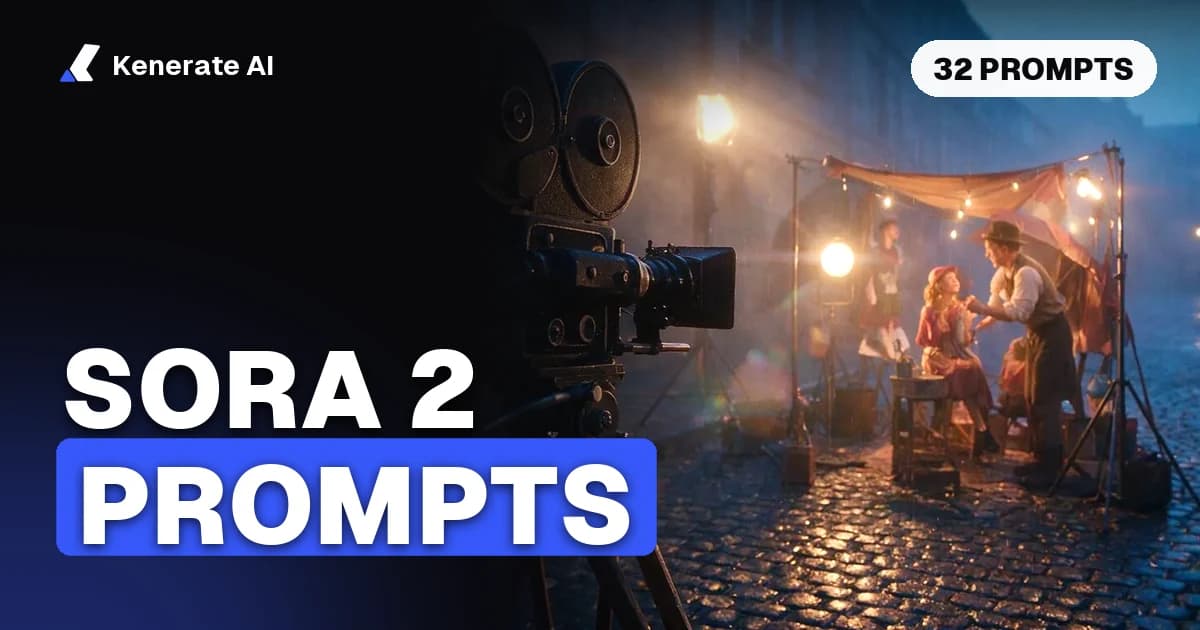
A good Sora 2 prompt reads like a brief for a cinematographer: name the visual style first, describe the scene in plain prose, give one camera setup and one camera move, list the action as a few short beats, then add dialogue as labelled lines. Clip length and frame size were never part of the prompt. They were set as separate parameters (4 to 20 seconds). One thing has changed since most Sora guides were written: OpenAI has discontinued Sora. The app closed on April 26, 2026 and the API on September 24, 2026, so the 32 prompts below are written to run on the video models you can still use today.
This guide was written on October 23, 2026. The prompting advice comes from OpenAI's own Sora 2 prompting guide and video generation docs, both of which OpenAI now keeps online for historical reference. The Kenerate AI details come from the studio's model configuration on the same date.
Can you still use Sora 2 in 2026?
No. Here is where each part of Sora stands today:
| What | Status | Source |
|---|---|---|
| Sora app and sora.com | Closed April 26, 2026 | OpenAI's discontinuation notice, as reported by The Decoder |
Sora 2 API (sora-2, sora-2-pro, Videos API) | Removed September 24, 2026 | OpenAI API deprecations page |
| Official replacement | None ("No one-to-one replacement API is available") | OpenAI video generation guide |
| Sora 2 Pro on Kenerate AI | Still in the model list (4–20 s, 720p/1080p, 90 credits/s at 720p), but hidden from the studio picker since the API shutdown | Kenerate video model config |
Your prompts still work, though. Sora 2 trained a lot of people to write shot-by-shot, sound-aware prompts, and that is how current models want to be prompted too. Veo 3.1, Seedance 2.5, Kling 3.0 and Wan 3.0 all generate synced sound and follow camera language. Our Sora 2 page shows the same prompt rendered on each of them.
What prompt structure does OpenAI recommend for Sora 2?
OpenAI's Sora 2 prompting guide says to "treat your prompt as a creative wish list, not a contract". You describe what you want, and the model still makes choices. It splits a prompt into four parts:
- Prose scene description. Who is in the shot, what they wear, where they are, the weather and the time of day.
- Cinematography. Shot framing, camera angle and mood.
- Actions. A short list of distinct beats, ideally timed ("takes four steps, pauses, pulls the curtain").
- Dialogue. A few short lines, sized to the clip.
Four rules from the same guide matter most:
- Name the style first. "1970s 35 mm film" or "16 mm black-and-white" frames every later choice.
- One camera move and one subject action per shot. Two moves in four seconds usually gives you neither.
- Be concrete. OpenAI's example: "wet asphalt, zebra crosswalk, neon signs reflecting in puddles" beats "a beautiful street at night". Naming 3 to 5 palette colours keeps the look stable across shots.
- Shorter clips follow instructions better. The guide suggests stitching two 4-second clips instead of generating one 8-second clip when you can.
A copy-paste Sora 2 prompt template
[Style: film stock, era or animation look]. [Scene: subject, wardrobe, location, weather, time of day]. Cinematography: [shot size], [angle], [lens / depth of field], [one camera move]. Mood: [one or two words]. Lighting and palette: [key light], [practical lights], palette of [3–5 colours]. Actions: [beat 1]; [beat 2]; [beat 3]. Dialogue:
- [Speaker A]: "[Short line.]"
- [Speaker B]: "[Short reply.]" Sound: [one ambience line and one sound effect].
Duration and size go in the tool's settings, never in the prose. As OpenAI's guide put it, those parameters are "the video's container".
Which camera and lighting words work in Sora 2 prompts?
Standard film vocabulary works, and it carries over to Veo, Kling, Seedance and Wan. For a longer list of moves with examples, see our AI video camera movement cheat sheet.
| You write | What it controls | Example phrase |
|---|---|---|
| Wide establishing shot, eye level | Framing | "wide establishing shot at eye level of the harbour" |
| Medium close-up, slight angle from behind | Framing | "medium close-up over her shoulder" |
| Shallow depth of field | Focus | "subject sharp, background lights soft bokeh" |
| Slow dolly-in / dolly-out | Movement | "slow dolly-in toward the window" |
| Handheld ENG-style camera | Movement | "handheld news-camera feel, slight shake" |
| Slow tilt up / crane up | Movement | "camera tilts slowly up to reveal the tower" |
| Tracking shot | Movement | "camera tracks alongside the cyclist" |
| Soft window light, warm practicals | Lighting | "soft window key light, warm lamp in the background" |
| Hard rim light | Lighting | "single hard rim light outlining the bottle" |
| Golden hour / blue hour | Time and colour | "low golden-hour sun, long shadows" |
| Palette of amber, teal, cream | Colour grade | "palette: amber, teal, cream, charcoal" |
How do you write dialogue in a Sora 2 prompt?
OpenAI's guide puts dialogue in its own block below the visual description, with each line attached to a speaker label. Three points from the guide:
- Keep speaker labels identical throughout the prompt, and alternate turns.
- Size speech to the clip. A 4-second shot holds one or two short exchanges, and an 8-second clip a few more. Long speeches tend to drift out of sync.
- Silent shots can still have one sound cue, such as a door click or a kettle, which gives the clip a rhythm.
When you move a Sora dialogue prompt to Veo 3.1, change the format slightly. Google's Veo guide puts the line in quotes straight after the speaker: The baker says, "First batch is always the best." Our Veo 3 prompt guide covers that format, plus SFX: and Ambient noise: labels.
32 Sora 2 prompt examples by genre
Every prompt uses fictional characters only. Set the length in the tool: 4–8 seconds suits most of them, and the multi-shot ones need 8 seconds or more.
Cinematic prompts
-
1970s 35 mm film, warm grain. A lone truck driver eats noodles at a roadside diner counter at 2 a.m. Medium close-up, eye level, slow dolly-in. Palette: amber, teal, cream. Actions: he lifts the bowl; a neon sign flickers outside; he looks up at the window. Sound: rain on glass, fridge hum.
-
Anamorphic widescreen, blue hour. A lighthouse keeper climbs a spiral staircase holding a lantern. Low angle looking up the stairwell, camera tilts slowly up. Shallow depth of field on the lantern flame. Sound: footsteps on iron, distant waves.
-
16 mm black-and-white film. A jazz trumpeter warms up alone in an empty club, chairs stacked on tables. Wide shot, static camera, single spotlight. Actions: three short notes; a pause; he wipes the mouthpiece. Sound: trumpet echo in the empty room.
-
Modern thriller look, cold palette of steel blue, grey and white. A woman in a long coat walks through an empty parking garage. Tracking shot at waist height, following from behind. Overhead strip lights buzz and flicker. Sound: heels on concrete, one light pops off.
-
Epic fantasy, golden hour. A knight in dented armour plants a banner on a hilltop as wind whips the cloth. Crane shot rising from his boots to a wide view of the valley. Palette: gold, rust, moss green. Sound: wind gusts, cloth snapping.
-
Neo-noir city at night: wet asphalt, zebra crosswalk, neon signs reflecting in puddles. A cyclist in a yellow raincoat crosses the frame left to right. Wide shot, static camera. Sound: tyres hissing on wet road, a distant siren.
Product and ad prompts
-
Premium commercial style. A matte black wireless speaker sits on wet slate as water droplets bead on its surface. Macro close-up, slow orbit around the product. Single hard rim light, dark studio. Sound: a low bass hit as the logo turns to camera.
-
Bright lifestyle ad, morning light. A ceramic coffee mug on a kitchen windowsill, steam rising. Medium close-up, slow push-in. Palette: cream, sage, terracotta. Actions: a hand lifts the mug out of frame. Sound: birdsong, a kettle clicking off.
-
Clean e-commerce look on a seamless white background. A white running shoe rotates on a turntable. Static camera, soft even lighting, crisp shadow under the sole. Actions: one full rotation, stop on the side profile. Sound: none.
-
Luxury skincare ad. A glass serum bottle on a marble ledge; a single drop falls from the dropper in slow motion. Extreme close-up, shallow depth of field. Soft window light, palette of blush, gold and white. Sound: a soft drip, quiet room tone.
-
Handheld UGC style, phone-camera look. A fictional woman in her thirties unboxes a pair of headphones at her desk and holds them up. Medium shot, slight handheld shake, natural window light. Dialogue:
- Woman: "Okay, these are lighter than I expected."
-
Food commercial, warm tungsten light. A burger is assembled in slow motion: bun, patty, cheese melting over the edge. Overhead top-down shot, static camera. Sound: sizzle, a soft thud as the top bun lands.
Nature and travel prompts
-
Wildlife documentary style. A red fox steps through fresh snow at dawn and stops to listen. Long lens, low angle at snow level, camera tracks slowly with the fox. Palette: white, orange, pale blue. Sound: crunching snow, wind through pines.
-
Aerial drone shot over turquoise rice terraces at sunrise, mist sitting in the valleys. The camera glides forward and tilts down slowly. Soft golden light. Sound: distant birds, light wind.
-
Underwater, clear tropical water. A sea turtle glides over a coral reef as light rays ripple across the sand. Medium wide shot, camera drifts alongside. Palette: aqua, coral, sand. Sound: muffled underwater ambience, bubbles.
-
Travel film, late afternoon. A narrow cobbled street in a hillside village, laundry lines overhead, a cat crossing. Handheld walking POV moving up the street. Warm light bouncing off stone walls. Sound: footsteps, a distant church bell.
-
Time-lapse feel. Storm clouds roll over a desert mesa, lightning in the distance. Wide shot, locked-off camera. Palette: purple, burnt orange, grey. Sound: rising wind, a far-off thunder roll.
-
Slow, calm mood. A wooden canoe drifts across a still mountain lake at dawn, mist on the water. Wide shot from the shore, slow pan right. Soft pastel sky reflected in the lake. Sound: water lapping, a loon call.
Dialogue prompts
-
1940s film noir, venetian-blind shadows. A tired detective sits behind a desk; a woman in a red coat stands at the door. Two-shot at eye level, static camera. Dialogue:
- Detective: "You're late."
- Woman: "I had to make sure nobody followed me." Sound: rain on the window, a ticking clock.
-
Bright sitcom look, kitchen set. Two flatmates argue over the last slice of pizza. Medium two-shot, slight push-in. Dialogue:
- Flatmate A: "You had three slices."
- Flatmate B: "Two and a half. That counts as two."
-
Sci-fi bridge of a starship, cool blue lighting. A captain turns from the viewscreen to her pilot. Medium close-up, shallow depth of field. Dialogue:
- Captain: "Take us in. Slowly."
- Pilot: "Aye, captain." Sound: the low hum of the engines.
-
Cosy bakery at 5 a.m., warm tungsten light, steam rising. A grey-haired baker pulls a tray of croissants from the oven and grins at the camera. Medium close-up, slow dolly-in. Dialogue:
- Baker: "First batch is always the best."
-
Documentary interview look. A fictional fisherman sits on an upturned crate on a dock, nets behind him. Medium shot, static camera, overcast soft light. Dialogue:
- Fisherman: "The sea doesn't care how tired you are." Sound: gulls, rope creaking.
-
Animated 3D family-film style. A small robot and a girl look up at a falling star from a rooftop. Wide two-shot, camera slowly cranes up. Dialogue:
- Girl: "Make a wish."
- Robot: "I wish for more wishes."
Multi-shot prompts
-
Style: modern thriller, cold palette. Shot 1: Wide shot of a courier running across a rooftop at night, camera tracking. Shot 2: Close-up of her hand grabbing a railing. Shot 3: Low-angle shot as she leaps the gap between buildings. Sound: footsteps, wind, a helicopter in the distance.
-
Style: warm lifestyle ad. Shot 1: Close-up of a hand pressing the button on a coffee grinder. Shot 2: Medium shot of coffee pouring into a glass cup. Shot 3: Wide shot of a sunny kitchen as a fictional man takes the first sip and smiles. Sound: grinding, pouring, birdsong.
-
Style: nature documentary. Shot 1: Aerial wide of a forest at dawn. Shot 2: Medium shot of a deer lifting its head. Shot 3: Close-up of dew dripping from a leaf. Sound: birdsong building over each cut.
-
Style: 1980s VHS home video. Shot 1: Handheld shot of a birthday cake carried into a dark room, candles lit. Shot 2: Close-up of a fictional kid blowing the candles out. Shot 3: Wide shot as the lights come on and the family cheers. Sound: muffled singing, then clapping.
Animation and stylised prompts
-
Stop-motion claymation. A clay snail in a tiny knitted scarf slides along a garden wall. Medium shot, static camera, soft daylight. Actions: it stops, looks at a raindrop, keeps going. Sound: a soft squelch, light rain.
-
2D hand-drawn anime. A girl on a bicycle rides down a hill road beside rice fields at sunset, scarf blowing. Wide shot, camera tracks alongside. Bright cel shading, pastel sky. Sound: a bicycle bell rings twice, cicadas.
-
Paper cut-out animation, layered textures. A paper whale swims through a sky of paper clouds above a small town. Wide shot, slow pan left. Palette: navy, cream, coral. Sound: soft wind chimes.
-
Watercolour illustration style. A small fishing boat sails across a lake at dusk. Wide shot, static camera, colours bleeding softly at the edges. Palette: indigo, rose, gold. Sound: water lapping, a single gull.
What will Sora 2 refuse to make?
OpenAI's video generation guide listed these guardrails for Sora 2:
- Real people, including public figures, cannot be generated.
- Input images with human faces were rejected, and character uploads showing a human likeness were blocked by default.
- Copyrighted characters and copyrighted music were rejected.
- Only content suitable for audiences under 18 was allowed.
The Sora app's cameo feature, where a person recorded their own likeness and controlled who could use it, closed with the app.
The same rule makes sense on any model: don't prompt a real person's likeness. Write fictional characters, which is why every example above says "a fictional woman" or describes a character instead of naming someone. Current models have their own filters. Google, for example, says Veo blocks prompts that break its usage terms and screens every output through safety filters.
How do you run Sora 2 prompts on Kenerate AI today?
Pick the model that matches what you used Sora for. Credits below are from the Kenerate AI video model configuration on October 23, 2026, charged per second of output.
| If you used Sora 2 for | Use this now | Clip length | Credits per second |
|---|---|---|---|
| Dialogue, synced sound effects | Veo 3.1 | 4, 6 or 8 s (+7 s extend) | 120 with sound, 60 silent (720p/1080p) |
| Cheap drafts of the same prompt | Veo 3.1 Fast | 4, 6 or 8 s | 45 with sound, 30 silent |
| Long single shots (12–20 s) | Seedance 2.5 | 4–30 s | 108 at 720p |
| Action, physical motion | Kling v3 Pro | 3–15 s | 50.4 with sound, 33.6 silent |
| Volume, vertical social clips | Wan 3.0 | 2–30 s | 15 at 480p, 30 at 720p |
Step by step:
- Open the video studio and choose a model from the table. Video generation needs a paid plan. The $15 Starter plan includes 1,300 credits (see pricing).
- Pick the mode. Use text-to-video for the prompts above, or image-to-video if you have a start frame. A start frame is the most reliable way to keep a product or character exact.
- Set length, resolution and aspect ratio in the settings, the same way Sora used
secondsandsize. Use 16:9 for YouTube and 9:16 for Shorts and Reels. - Paste the prompt. For Veo 3.1, change the
Dialogue:lines toName says, "line". Seedance, Kling and Wan read the labelled format fine. - Draft short. Run 4–5 seconds on Veo 3.1 Fast or Wan 3.0 at 480p, then re-run the keeper at full length and resolution. The studio shows the exact credit cost before each run.
Need more ideas in the same format? Our 42 AI video prompts are sorted by use case and work on all of these models.
What are the most common Sora 2 prompt mistakes?
- Putting the length in the prompt. "A 20-second video of…" does nothing. Set the duration in the tool.
- Stacking camera moves. "Dolly in, then pan, then crane up" in 8 seconds gives a wobbly compromise. Use one move per shot.
- Vague adjectives. "Beautiful, cinematic, epic" tells the model nothing. Name the light, the lens and three palette colours.
- Too much dialogue. A paragraph of speech in a 4-second clip comes out rushed or out of sync.
- Changing the character between shots. Copy the same description word for word into every prompt, or use a start frame.
- Naming real people or famous characters. The prompt gets blocked on Sora and on most other models. Describe an original character instead.
Sources
- OpenAI Cookbook, "Sora 2 Prompting Guide" (archived, updated March 2026): https://developers.openai.com/cookbook/examples/sora/sora2_prompting_guide
- OpenAI API docs, "Video generation with Sora" (guardrails, shutdown notice): https://developers.openai.com/api/docs/guides/video-generation
- OpenAI API docs, "Deprecations" (Videos API and Sora 2 removal, September 24, 2026): https://developers.openai.com/api/docs/deprecations
- The Decoder, "OpenAI sets two-stage Sora shutdown" (March 28, 2026): https://the-decoder.com/openai-sets-two-stage-sora-shutdown-with-app-closing-april-2026-and-api-following-in-september/
- Kenerate AI video model configuration and plan pricing, read October 23, 2026.