


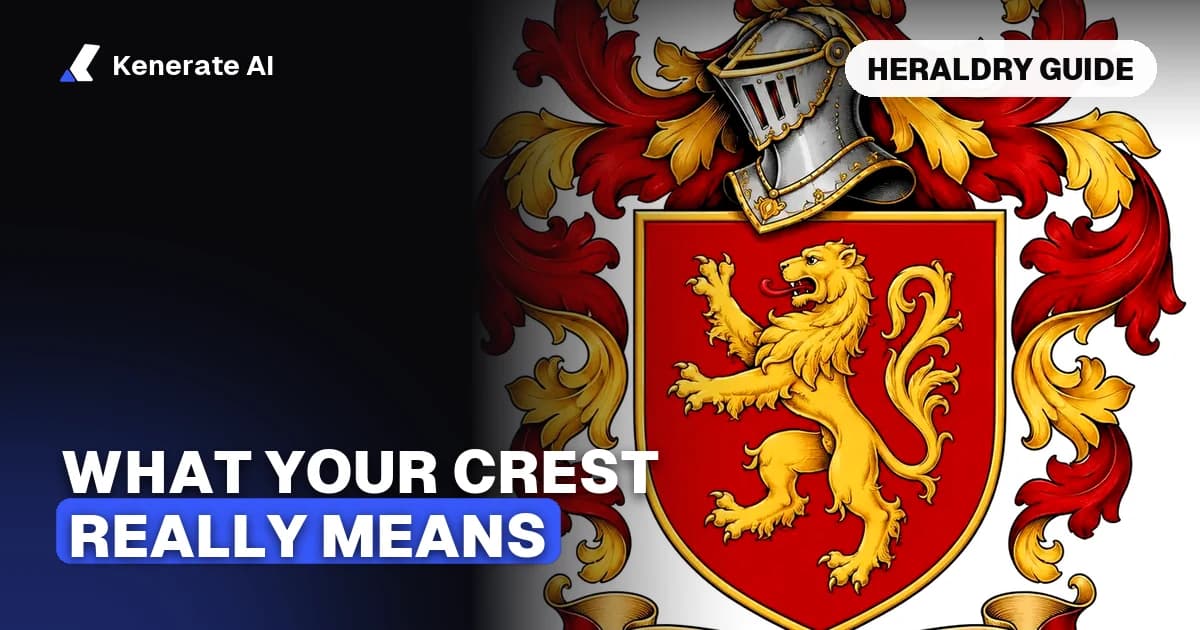
Coat of arms symbols carry traditional meanings: the lion stands for courage, the oak for endurance, the tower for defence, and colours like red (gules) and blue (azure) are read as courage and loyalty. Those readings, though, were mostly attached by writers between the 15th and 17th centuries — in the 12th century, when heraldry began, designs were chosen to be recognisable in battle, not to encode virtues. This guide explains every part of a coat of arms, the tinctures and the rule that governs them, the most common charges and their traditional meanings, and how to design a crest of your own with an AI coat of arms generator.
What are the parts of a coat of arms?
A complete heraldic design is called an achievement of arms. The "coat of arms" in the strict sense is only the design on the shield, but a full achievement stacks several elements around it, and each has a name and a job. Heraldic designs came into general use among European nobility in the 12th century and had become systematic and hereditary by the early 13th century, so these parts have stayed remarkably stable for 800 years.
| Part | What it is | Where it sits |
|---|---|---|
| Escutcheon (shield) | The core of the arms — the field, its divisions and the charges on it | Centre |
| Helm (helmet) | Shows rank in formal heraldry; a closed helm for gentlemen, barred for peers | On top of the shield |
| Torse (wreath) | A twisted band of cloth in the main colours | Between helm and crest |
| Crest | A single figure — an animal, arm or plume — that sat on top of the real helmet | Above the torse |
| Mantling | Stylised cloth flowing from the helm, usually in the shield's main colour and metal | Draped either side |
| Supporters | Animals or figures holding the shield upright; historically reserved for higher ranks | Left and right |
| Motto | A short phrase, often Latin, on a scroll | Below the shield (above it in Scotland) |
| Compartment | The ground the supporters stand on | Beneath everything |
Two useful rules of thumb when you read (or design) arms: the shield is the identity — everything else is decoration around it — and simpler is older. Medieval arms often held a single charge on a plain field; crowded, quartered designs usually came later.
What do the colours on a coat of arms mean?
Heraldry's colours are called tinctures, and they divide into metals, colours and furs. The two metals are Or (gold, usually painted yellow) and Argent (silver, usually white). The five classic colours are Gules (red), Azure (blue), Sable (black), Vert (green) and Purpure (purple). The furs — patterns rather than flat colours — include ermine (white strewn with black tails, from the stoat's winter coat) and vair (interlocking blue-and-white panes, from squirrel fur).
| Tincture | Heraldic name | Traditional meaning |
|---|---|---|
| Gold / yellow | Or | Generosity, elevation of mind |
| Silver / white | Argent | Peace, sincerity |
| Red | Gules | Courage, military strength |
| Blue | Azure | Loyalty, truth |
| Black | Sable | Constancy, sometimes grief |
| Green | Vert | Hope, joy |
| Purple | Purpure | Royal majesty, justice |
Treat that table as convention, not law. As of 28 October 2026, no heraldic authority assigns official meanings to tinctures. The virtue readings come from late-medieval and Renaissance writers: in the 1350s Bartolo de Sassoferrato linked gold to the sun and red to fire, and in 1414 Jean Courtois paired every tincture with a gemstone and a planet — Or with topaz and the sun, Gules with ruby and Mars, Azure with sapphire and Jupiter. Those systems were fashionable from roughly the 15th to the 17th century and then fell away. If you are designing your own crest, that is liberating: pick colours because they mean something to you, and history is on your side.
What is the rule of tincture?
The one rule almost every coat of arms follows: never put colour on colour, or metal on metal. A gold lion on a red field reads instantly; a blue eagle on a red field turns to mud at a distance — which mattered when the "distance" was the far end of a battlefield. The rule exists purely for contrast, and it is still the single best tip for making a modern crest legible: choose one metal (gold or silver/white) and one or two colours, and alternate them between field and charges.
What do common heraldic symbols (charges) mean?
Anything drawn on the shield is a charge. Genealogy references assign traditional meanings to the popular ones — with the same caveat as the colours: most meanings were attributed centuries after the symbols were first used, and many medieval charges were simply puns on the bearer's name (a family called Lucy used pikes, the fish being "luces"; Corbet used corbeaux — ravens).
| Charge | Traditional meaning |
|---|---|
| Lion | Courage, strength — the most common heraldic beast |
| Eagle | Power, nobility; the classic charge of German Wappen |
| Stag | Peace, one who will not fight unless provoked |
| Bear | Strength, protection of kin |
| Boar | Bravery, fighting to the death |
| Wolf | Perseverance; in Nordic arms, ties to land and legend |
| Owl | Wisdom, vigilance |
| Oak tree | Endurance, longevity |
| Acorn | New beginnings, potential |
| Tower / castle | Defence, a fortified home |
| Cross | Faith, sacrifice, remembrance |
| Star (mullet) | Honour, aspiration |
| Crescent | Hope; also the mark of a second son |
| Anchor / ship | Seafaring ancestors, steadfast hope |
| Sheaf of wheat | Agricultural roots, plenty |
| Fleur-de-lis | Purity; strongly tied to French royal arms |
| Chevron | Protection, the roof of a house — builders and protectors |
| Sword | Justice, military honour |
What are divisions and ordinaries?
Before charges go on, the field itself can be split or striped, and these patterns have names too.
Divisions cut the field into blocks of different tinctures: per pale (split vertically), per fess (horizontally), per bend (diagonally), quarterly (in four — the classic way of combining two families' arms after a marriage) and per saltire (in an X).
Ordinaries are the broad geometric bands laid over the field: the chief (a band across the top), fess (across the middle), pale (vertical stripe), bend (diagonal), chevron (inverted V), cross and saltire (diagonal cross). They are the oldest and simplest charges — easy to paint on a shield and recognisable through the dust of a melee — and they still make the cleanest modern designs.
What is the difference between a family crest and a coat of arms?
Strictly, the crest is only the figure on top of the helmet — one component of the full achievement — while the coat of arms is the design on the shield. In everyday speech "family crest" has come to mean the whole thing, and search engines treat the two phrases almost interchangeably, but heralds will correct you: you can have arms without a crest, and the crest never appears alone on the shield.
One more distinction matters if you care about history. Arms belong to individuals, not to surnames. In the English and Scottish traditions a grant of arms was made to one person by letters patent and passed to their descendants like legal property. England's College of Arms and Scotland's Court of the Lord Lyon still regulate grants today — in Scotland, using someone else's arms is actually a criminal matter for the Lyon Court. So the "coat of arms for the Smith family" sold on mugs and scrolls is a generic design attached to a surname, not something every Smith is entitled to. Arms were also never limited to kings: merchants, landowners, clergy and military officers were granted them too.
How do I design my own coat of arms with AI?
Since no authority hands out meanings, designing a personal crest is legitimate and always has been — you are doing what every new armiger did: choosing symbols that say something about you. An AI generator gets you from description to finished artwork in about a minute. Here is the workflow we use on Kenerate's family crest maker, as of 28 October 2026:
- Pick one or two charges from the table above that match your family's story — a trade, a place, a value. One strong lion beats five tiny symbols; medieval arms were simple for a reason.
- Choose tinctures with the rule of tincture — one metal, one or two colours. Gold on red, silver on blue and gold on green are classic, high-contrast pairs.
- Write the prompt like a blazon. Describe shield colours and charges, what sits above (helm, crown or crest animal), optional supporters, then put the family name and motto in quotes: "Coat of arms for the family 'HARTWELL': golden lion on a red shield, knight's helmet with mantling, banner reading 'FORTIS ET FIDELIS', classic heraldry, white background."
- Generate with a text-reliable model. On Kenerate, GPT Image 2 spells names and mottos most reliably (18 credits at 1K, 30 at 2K, 54 at 4K for print); Qwen Image 3.0 is the free-plan option at 9 credits. Run a few variations and keep the best.
- Finish for its final home. Upscale to 4K for a framed print, remove the background in Edit Studio for merch, or adapt the design into a flag, a poster, stickers or even a tattoo design.
Styles worth trying beyond classic heraldry: vintage engraving (looks like a 19th-century bookplate), Celtic clan badge (strap-and-buckle ring with knotwork), fantasy house sigil, and flat modern monogram with a laurel wreath and an "EST." year.
Be honest about what you are making: an AI crest is a new, personal design, not a historical document or an official grant of arms. If you want a legally granted coat of arms in England or Scotland, that petition goes to the College of Arms or the Lord Lyon — a multi-year, paid, formal process. For a family reunion T-shirt, a wedding monogram or a D&D house sigil, a generator and a good prompt will do nicely.
Sources
- Coat of arms — Wikipedia — origins, heritability, regulation by the College of Arms and Lord Lyon
- Tincture (heraldry) — Wikipedia — metals, colours, furs, rule of tincture, attributed meanings (Bartolo de Sassoferrato, Jean Courtois)
- Coat of Arms Examples: Understanding Heraldry Symbols — GenealogyBank — traditional charge meanings, surname-arms myths
- Coat of arms — Encyclopaedia Britannica — definition and the surcoat origin of the term