

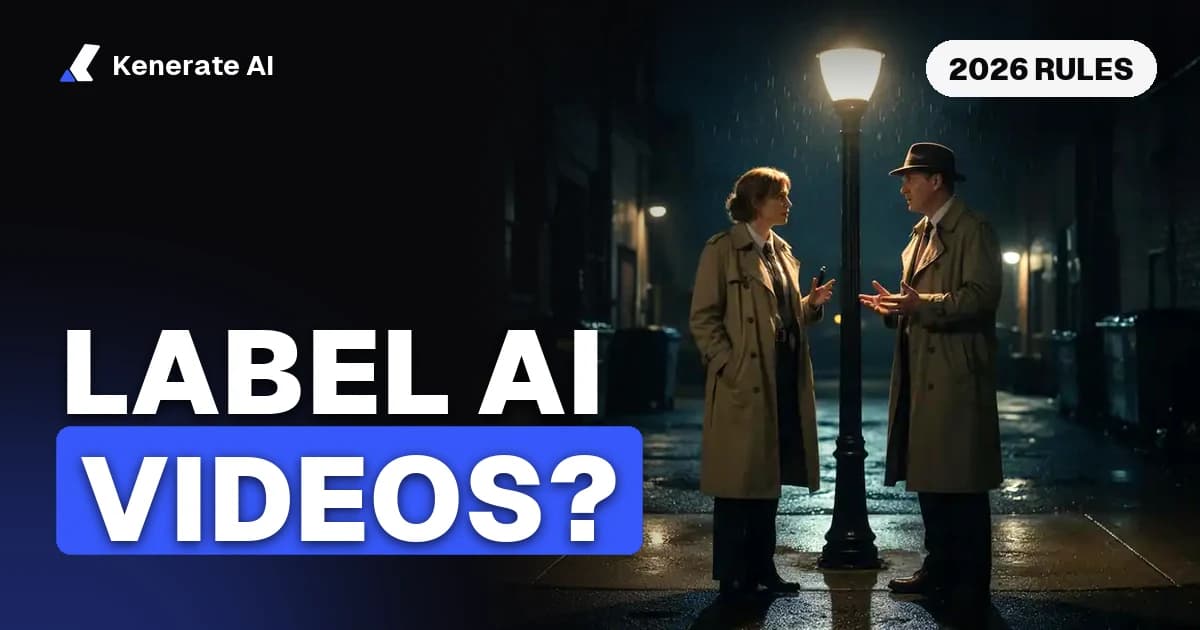
Yes, in most cases where the video looks real. As of 31 October 2026, YouTube, TikTok and Meta (Instagram and Facebook) all ask creators to label realistic AI-generated or AI-altered video, and in the EU, Article 50 of the AI Act has required deepfake disclosure since 2 August 2026. Clearly unrealistic content (cartoons, fantasy, obvious effects) and minor AI help such as captions, color fixes or upscaling usually do not need a label.
This guide explains exactly when a label is required on each platform, how to add it in a few taps, what happens if you skip it, and what the EU law actually says. It is a practical summary, not legal advice: rules change, and if your business depends on it, check the official pages linked below or ask a lawyer.
Do AI videos have to be labeled? The short answer by platform
The rule that ties every platform together is realism. Nobody asks you to label a talking cartoon cat. Everyone asks you to label a video that a reasonable viewer could mistake for real footage of a real person, place or event.
| Platform / law | When a label is required | How to add it | What happens if you don't |
|---|---|---|---|
| YouTube | Realistic content that makes a real person say or do something they didn't, alters footage of a real event or place, shows a realistic scene that never happened, or uses AI music as the main focus | YouTube Studio → upload → Attributes → "AI use" → Yes | YouTube may add the label itself; repeat offenders risk removal or suspension from the YouTube Partner Program |
| TikTok | Realistic AI-generated or significantly AI-edited content | Post screen → More options → turn on "AI-generated content" | TikTok can auto-label (including via C2PA Content Credentials); unlabeled realistic AI content can be removed |
| Instagram / Facebook (Meta) | Realistic video, image or audio that was fully generated or meaningfully altered with AI | Share screen → turn on "Add AI label" | Meta can apply an "AI info" label from industry signals; Meta says penalties may apply if you don't label when required |
| EU AI Act, Article 50 | Deepfakes (realistic content resembling real people, places or events) published by a "deployer", from 2 August 2026 | Clear disclosure at first exposure; for evidently artistic or satirical work, a light-touch mention is enough | Fines for breaching Article 50 duties can reach €15 million or 3% of worldwide annual turnover |
The sections below go through each row in detail.
Does YouTube require AI disclosure?
Yes, for realistic content. YouTube's help page "Disclosing use of altered or synthetic content" says you must disclose AI-generated or altered content that seems realistic. Its own examples of content that needs the disclosure include:
- Making a real person appear to say or do something they didn't
- AI-generated extra footage of a real place, or a realistic tornado heading toward a real city that never happened
- A realistic AI video of a match between two real professional athletes
- AI-generated music that is the main focus of the video
Content that does not need it:
- Clearly unrealistic content, such as a fully animated video
- Minor aesthetic edits: beauty filters, color or lighting fixes, background blur
- Production help: using AI to draft a script, title or thumbnail, auto-captions, upscaling, audio repair
- Cloning your own voice for your own voice-over or dubs
How do you add the AI label on YouTube?
- Open YouTube Studio and start an upload.
- In the Attributes section, find AI use and select Yes if the video contains realistic altered or synthetic content.
- Finish the rest of the details and publish.
For photorealistic content and AI music, the label shows on the video player; for animated or non-photorealistic AI content it appears in the expanded description. YouTube can also apply the label automatically, for example to videos made with its own generative tools, files carrying C2PA metadata, or content its systems detect. Those automatic labels generally cannot be removed.
Does labeling hurt views or monetization on YouTube?
YouTube says that disclosing AI use does not by itself limit a video's audience or its eligibility to earn money. The real monetization risk is not disclosing: creators who consistently skip the label can face content removal or suspension from the YouTube Partner Program. Monetization of AI channels is a separate question (originality and "inauthentic content" rules), which we cover in Are AI videos monetized on YouTube?.
Does TikTok require an AI-generated label?
Yes. TikTok's Community Guidelines require creators to label AI-generated content that shows realistic scenes, and TikTok has offered a built-in "AI-generated content" toggle since 2023. The trigger is realism, not the fact that a tool used AI somewhere in the pipeline.
How do you label AI content on TikTok?
- Record or upload your video and go to the post screen.
- Tap More options.
- Turn on AI-generated content.
- Post. Viewers see an "AI-generated" tag (or "Creator labeled as AI-generated") under the video.
You can also add your own clear caption, sticker or on-screen text, but the toggle is the most reliable option because it uses TikTok's standard wording.
Does TikTok detect AI videos automatically?
Partly. In May 2024 TikTok became one of the first video platforms to read C2PA Content Credentials, metadata that some AI tools attach to images and video to record how they were made. If your upload carries those credentials, or was made with TikTok's own AI effects, TikTok may label it automatically. Content Credentials are not foolproof (metadata can be stripped when a file is re-encoded), so TikTok still expects creators to self-label. Realistic AI content that is not labeled can be taken down. For what tools short-form creators actually use, see What AI video generator do TikTokers use?
How do you label AI content on Instagram and Facebook?
Meta uses one system across Instagram, Facebook and Threads. Content is marked "AI info", either because you labeled it or because Meta detected industry signals (such as C2PA or IPTC metadata) from the tool that made it.
- Create your Reel or post as usual and continue to the share screen.
- Turn on Add AI label.
- Share. Viewers can tap AI info to see the label details.
Meta asks you to use the label for realistic video, images or audio that were digitally created or meaningfully altered, and says penalties may apply if you don't. Since late 2024, posts that were only edited with AI tools (rather than fully generated) show the "AI info" note in the post menu instead of directly on the post, so a small AI retouch is less prominent than a fully synthetic video.
What does the EU AI Act say about labeling AI videos?
The EU AI Act's transparency rules in Article 50 apply from 2 August 2026. They split the job in two:
- Providers of AI systems that generate video, images, audio or text (the companies that build the models) must make the output "marked in a machine-readable format and detectable as artificially generated or manipulated" where technically feasible. That is the reason more AI files now carry watermarks and Content Credentials.
- Deployers (anyone using AI in a professional capacity, which can include businesses, agencies and monetized creators) who publish a deepfake must disclose that the content was artificially generated or manipulated. The disclosure has to be clear and given at the latest at the first exposure.
There is an important carve-out for creative work. If the video is evidently artistic, creative, satirical or fictional, you only need to disclose that AI content exists "in an appropriate manner that does not hamper the display or enjoyment of the work". A short line in the description or end card typically fits that description.
Penalties for breaching these transparency duties can reach €15 million or 3% of total worldwide annual turnover, whichever is higher (Article 99). Purely personal, non-professional use is outside the deployer duties.
What about the US and other countries?
As of 31 October 2026 there is no general federal US law requiring AI video labels. A bipartisan AI Labeling Act was reintroduced in the Senate in June 2026 but has not passed. Some states have their own rules, mostly around election deepfakes and AI in political ads. Outside the EU, Vietnam's Law on Artificial Intelligence requires AI-generated images and video to be labeled in a recognizable way from 1 March 2026, and China has required visible and metadata labels on AI content since September 2025. If you publish for a specific country, check its current rules. In practice, the platform rules above are what most creators hit first, because they apply worldwide.
Which AI videos do NOT need a label?
Across YouTube, TikTok and Meta, these uses are generally fine without a label:
| Use of AI | Label needed? | Why |
|---|---|---|
| Fully animated or clearly fantastical video (dragons, talking animals, anime) | Usually no | Viewers can't mistake it for real footage |
| AI script, title or thumbnail ideas | No | Production help, not the content itself |
| Auto-captions, translation subtitles, upscaling, noise removal | No | Minor or assistive edits |
| Color grading, beauty filter, background blur | No | Aesthetic edits |
| Your own cloned voice reading your own script (YouTube) | No | YouTube lists this as exempt |
| Realistic AI B-roll of a real city or event | Yes | A realistic scene that didn't happen |
| A realistic AI "person" presenting a product or news | Yes | Could be mistaken for a real human |
| A real person made to say or do something they didn't | Yes, and often banned | Deepfake rules; also needs that person's consent |
| AI music as the main focus of a YouTube video | Yes | Listed by YouTube |
When in doubt, label. All three platforms say an honest label does not reduce reach on its own, while a missing label can.
How do you label an AI video correctly? A 5-step checklist
- Ask the realism question. Could a viewer believe this shows a real person, place or event? If yes, label it.
- Use the platform toggle, not just a hashtag. "AI use" on YouTube, "AI-generated content" on TikTok, "Add AI label" on Instagram and Facebook.
- Add a plain-language line in the caption or description, such as "Made with AI video generation". This also covers the EU's light-touch rule for creative work.
- Keep your source files. If a platform auto-labels you by mistake or questions a video, the original generations and prompts show how it was made.
- Never use real people without consent. Labeling does not make an impersonation or a fake endorsement acceptable. Our guide Are AI video generators safe? covers privacy and deepfake risks in more depth.
Do AI video generators add watermarks or labels automatically?
It depends on the model and the tool. Google says every Veo video carries an invisible SynthID watermark, and OpenAI says its image outputs include C2PA metadata. Other models add nothing. Watermarks and metadata help platforms detect AI content, but they are not a substitute for the creator's label, because metadata is often lost when a clip is edited, trimmed or re-exported.
On Kenerate, downloads come without a visible Kenerate watermark, so the label is your job. You can generate clips with models like Seedance, Kling, Wan and Veo in one place on the AI video generator, start from a script with text to video, or make a presenter clip with the AI avatar video generator, then turn on the platform's AI label when you post. Kenerate's terms also ban face swapping real people and deceptive impersonation.
Bottom line
Do AI videos have to be labeled as AI? If they look real, yes: on YouTube, TikTok, Instagram and Facebook, and for deepfakes under EU law since 2 August 2026. If they are obviously animated or fantastical, or AI only helped with captions, colour or upscaling, you usually don't need a label. Flip the platform's AI toggle whenever you are unsure; it costs nothing in reach and protects your channel.
Rules checked against official platform help pages and the EU AI Act text as of 31 October 2026. This article is general information, not legal advice.