


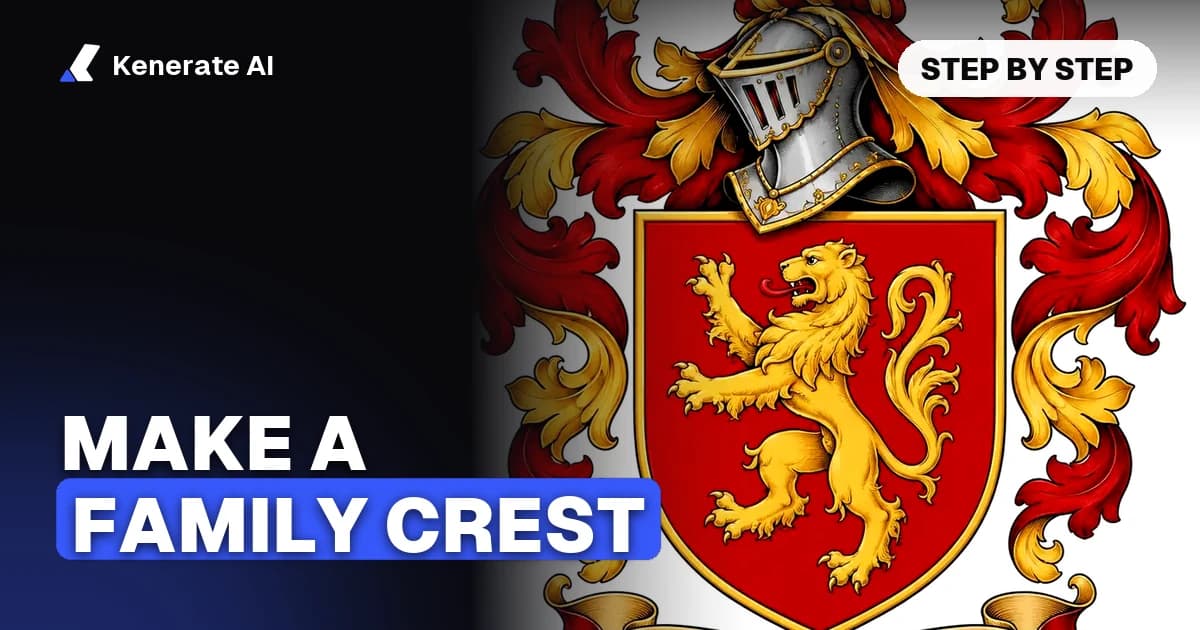
To make a family crest, choose what your family wants it to say, pick a shield shape, choose one metal and one colour, add one or two symbols, then add a motto and draw it by hand or generate it. Keep the design simple and make sure it's your own. A new design is a personal emblem, not an official grant of arms, and the steps below work either way, as of 4 November 2026.
This is the practical how-to. For what each lion, oak and colour traditionally stands for, keep our coat of arms symbols and meanings guide open beside it.
Can you just make your own family crest?
Yes, for personal use. Before you start, it helps to know two things that surprise most people.
There's usually no ready-made crest for your surname. The American Heraldry Society says that in the UK, Ireland, the Commonwealth and, by tradition, the US, there's no such thing as a "family" coat of arms. Arms belong to an individual and pass to their heirs. Shops selling "your surname's crest" are often showing arms that belonged to one unrelated person with the same name. Designing your own is the more honest option.
"Family crest" isn't quite the right term. Strictly, the crest is only the figure on top of the helmet, and the coat of arms is the design on the shield. Most people say "family crest" for the whole thing, so we do too. If you want the formal names, the symbols guide has a full parts table.
Official arms are a separate matter. The Heraldry Society notes that in England they are granted by the Crown through the Earl Marshal and the College of Arms. In Scotland, the Lord Lyon grants them. If you want an official grant, apply to the authority for your country. In the US there's no official authority, and the American Heraldry Society points to the Committee on Heraldry of the New England Historic Genealogical Society, which registers newly assumed arms.
What are the steps to make a family crest?
| Step | Decision | Quick rule |
|---|---|---|
| 1 | The story | Pick two or three things that define your family |
| 2 | Shield shape | The classic pointed "heater" suits almost everything |
| 3 | Colours | One metal plus one colour |
| 4 | Symbols | One main charge, two at most |
| 5 | Crest and helmet | Optional, so keep it simple |
| 6 | Motto | Short, and easy to say |
| 7 | Originality check | Make sure it isn't someone else's |
| 8 | Draw or generate | By hand, in a vector app or with AI |
Step 1: What should your crest say about your family?
Start with a list, not a drawing. Write down the things your family would recognise straight away:
- Places: a home town, a river, a coast, a country you came from.
- Work: a trade running through the family, such as farming, baking, sailing or engineering.
- Values: patience, loyalty, curiosity, hospitality.
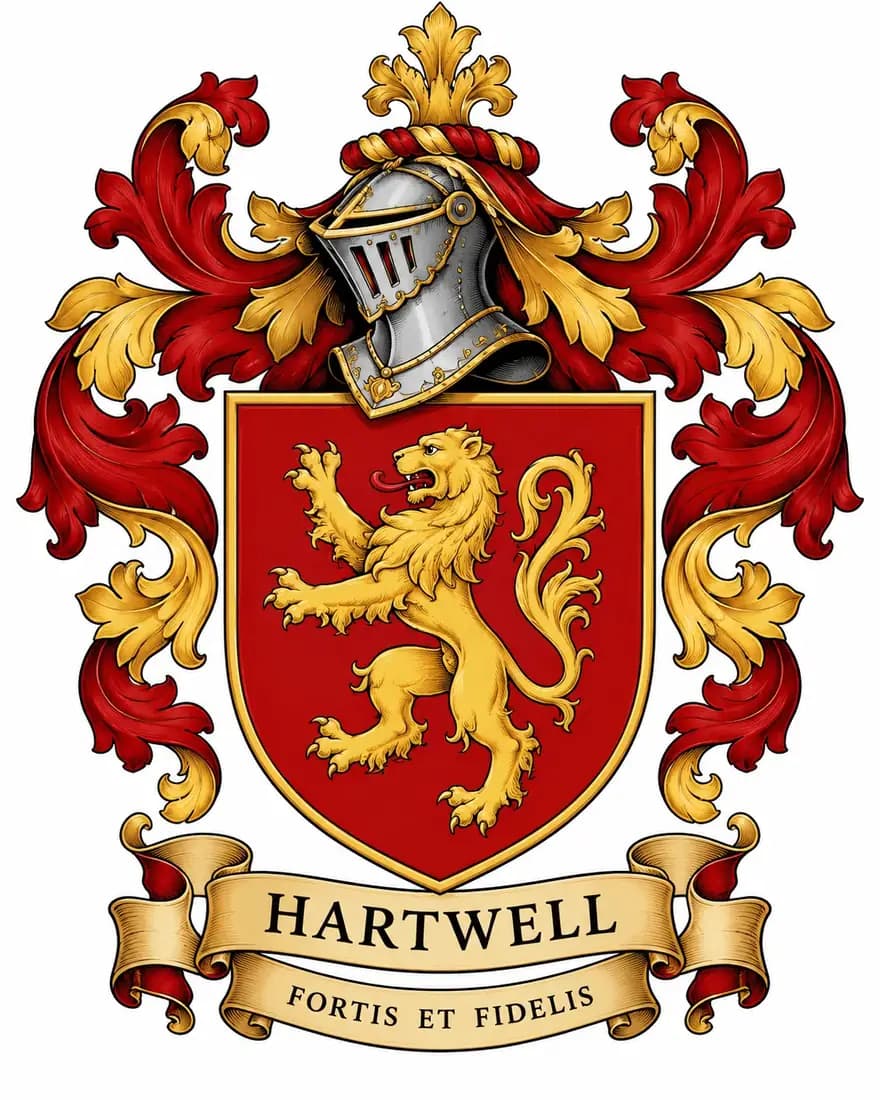
- Names: a surname that sounds like an object. Heraldry calls these "canting arms", and they're a fun tradition. A family called Hartwell might use a hart, which is a stag.
Choose two or three items at most. Everything else should stay off the shield.
Step 2: Which shield shape should you pick?
The American Heraldry Society's guidelines treat shield shape as a matter of taste. Three common choices:
- Heater: flat top, pointed base. It's the classic look, and the safest pick.
- Round-based: flat top, curved base, often called Iberian or Spanish style.
- Oval or circular: a softer look, which works well on seals and stamps.
Pick the shape that suits how you'll use the design. A square-ish shield is easier to embroider, and a tall one fits a bookplate.
Step 3: Which colours should you use?
Heraldry uses a small palette, and that's why good arms stand out. There are two metals, gold and silver (usually drawn as yellow and white), and five main colours: red, blue, green, black and purple.
The key design rule is the rule of tincture: don't put metal on metal or colour on colour. A gold lion on a red field reads clearly from far away. A red lion on a blue field doesn't. Furs such as ermine are generally exempt, and so are simple field divisions, but you don't need them to start.
A simple recipe: a colour for the field, and a metal for the main symbol, or the other way round. Then stop. Two tinctures usually look better than five. For the traditional meaning of each colour, see the symbols guide.
Step 4: Which symbols should go on the shield?
Symbols on a shield are called charges. Take your list from step 1 and turn it into objects:
| If your family is about | Try this charge |
|---|---|
| The sea or sailing | An anchor, a ship, wavy lines |
| Farming or roots | An oak, a wheat sheaf, a plough |
| Teaching or study | An open book, a lamp |
| Baking or cooking | A wheat sheaf, a loaf, a millstone |
| Music | A harp, a horn |
| Courage | A lion, a tower |
Now apply the American Heraldry Society's advice: simpler designs are generally better. It says new arms should usually use a single field, because quartered shields can look like a combination of existing arms. Charges normally face the viewer's left. And the design should stay graphic, so avoid writing on the shield itself. The name and motto go on a scroll below it.
Test the design by shrinking it. If you can't tell what it is at thumbnail size, take something off.
Step 5: Do you need a helmet, crest or supporters?
No. The society's guidelines describe a crest as customary but optional. Add these extras only if you want the full traditional look:
- Helmet: a plain steel helm is the sensible choice.
- Crest: one simple figure above the helmet.
- Mantling: the flowing cloth around the helmet, in your main colours.
- Supporters: animals or figures either side of the shield. They look impressive, but they add clutter.
The guidelines also advise against coronets and other marks that suggest noble rank or honours you don't hold, and against including the arms of a country, state or ruling house.
Step 6: How do you write a family motto?
Mottoes are the most personal part, and the most flexible. The society's guidelines note that a motto isn't part of the arms themselves and can be changed freely. Good mottoes share a few habits:
- Keep it short: two to five words read best on a scroll.
- Pick a language you can defend. English is fine. Latin is traditional, but get it checked, because translation slips are common.
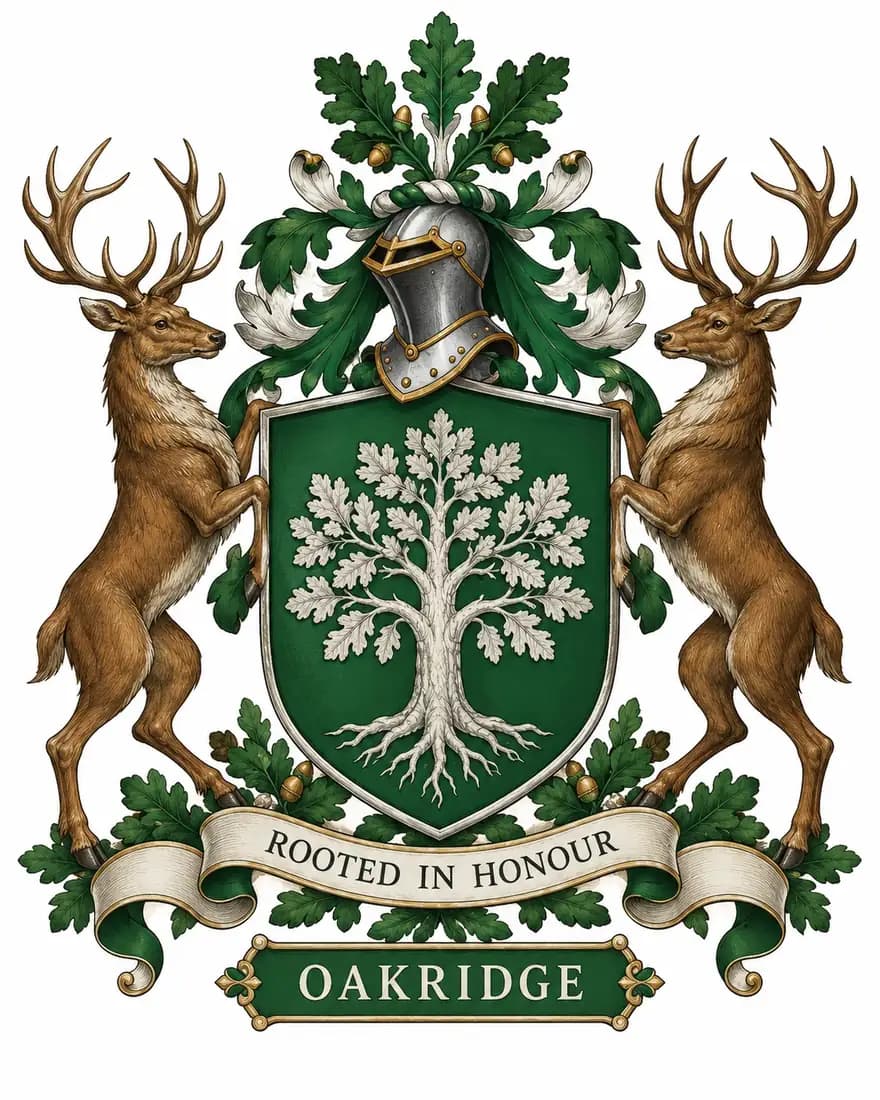
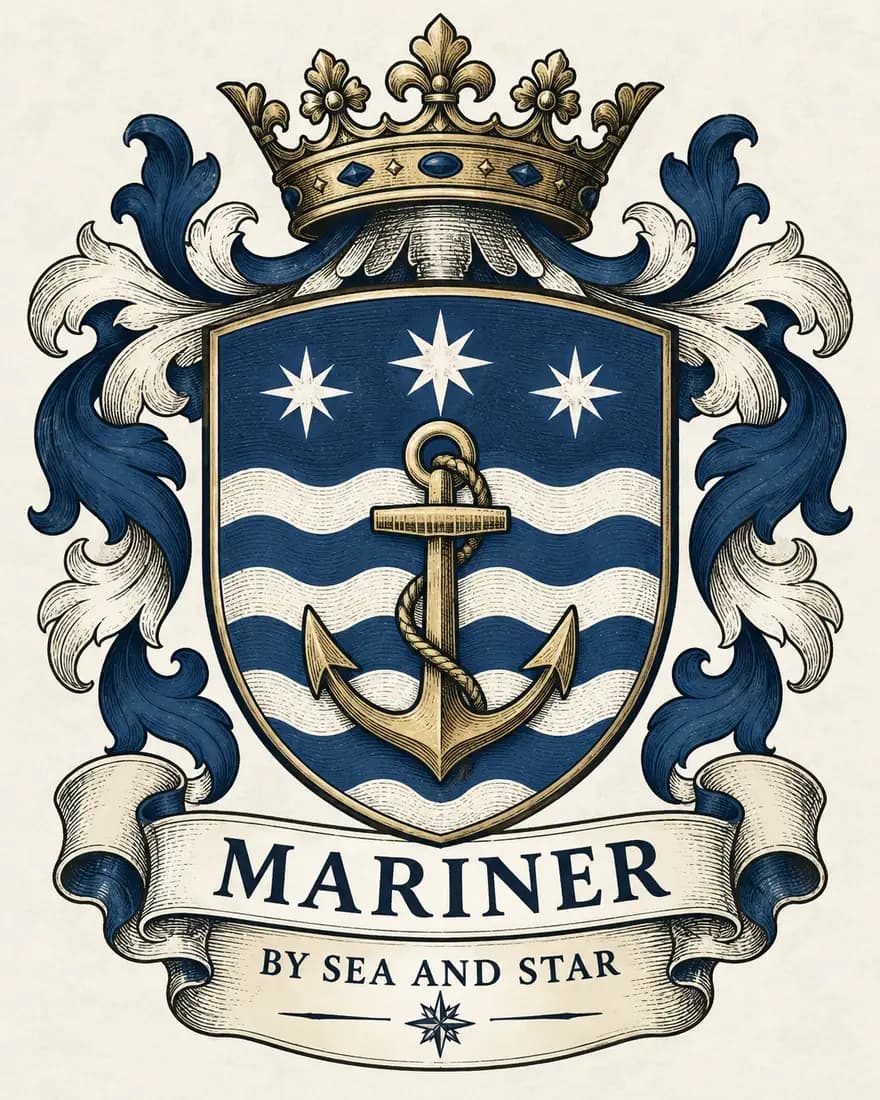
- Make it a promise, not a boast. Examples from the crests below: "By sea and star", "Rooted in honour".
- Say it out loud. If it doesn't sound right spoken at a family gathering, rewrite it.
Step 7: How do you check that your crest is original?
The guidelines say a design should be unique as far as possible, and that deliberately taking someone else's arms is a serious lapse. Sharing a surname gives you no right to the arms of others with that name.
Before you finish, search your main elements in plain words, such as "gold lion on red shield coat of arms", and look through image results. If you find a near match, change the charge or the colours. Also avoid well-known logos and sports crests.
Step 8: Should you draw it by hand or use AI?
Both work. It comes down to your skills and what the crest is for.
| By hand or in a vector app | With an AI generator | |
|---|---|---|
| Control | Every line is yours | Described in words, then refined |
| Time | Hours | Minutes per draft |
| Best for | A logo-style design, embroidery, cutting files | Trying many ideas, detailed classic looks |
| Skill needed | Drawing or vector software | Clear description |
| Watch for | Uneven symmetry | Misspelled words, extra details |
By hand: sketch the shield with a ruler, draw the charge large and centred, and leave clear space around it. Trace it in a vector app if you plan to print or cut it. Limit yourself to your chosen tinctures.
With AI: describe each part in order. The family crest maker on Kenerate AI is built for this. A template you can fill in:
Heraldic family crest for the fictional family "[NAME]": [SHAPE] shield with a [METAL] [CHARGE] on a [COLOUR] field, knight's helmet with [COLOUR] and [METAL] mantling, scroll below reading "[MOTTO]", classic heraldic illustration, clean lines, white background. No other text anywhere.
What does a finished example look like?
Here is that process for a fictional family, the Ashdowns: bakers by trade, from a town by the sea.
- Story: baking and the coast.
- Shield: heater.
- Colours: blue field and gold charge.
- Symbols: a wheat sheaf, with a wavy gold line below it for the sea.
- Extras: a simple helmet, no supporters.
- Motto: "Bread and open doors".
- Check: a search for similar wheat sheaf arms before finalising.
Heraldic family crest for the fictional family "ASHDOWN": heater shield with a gold wheat sheaf above a wavy gold line on a blue field, knight's helmet with blue and gold mantling, scroll below reading "BREAD AND OPEN DOORS", classic heraldic illustration, clean lines, white background. No other text anywhere.
These two are real outputs from the family crest maker page, also made for fictional families. Notice how each one has a single clear idea.
Which Kenerate model should you use for a crest?
Prices are from Kenerate's model config, as of 4 November 2026, for one image at 1K.
| Model | Credits | Best for |
|---|---|---|
| GPT Image 2 (medium) | 18 | The most careful lettering on names and mottoes. 30 at 2K, 54 at 4K |
| GPT Image 2.5 Sunburst (medium) | 7.2 | Cheaper drafts with readable text. 12 at 2K, 21 at 4K |
| Qwen Image 3.0 | 9 | Open to free accounts |
New accounts get 25 credits, which is enough for two Qwen Image 3.0 drafts. Downloads have no watermark. Always zoom in and check the spelling of your name and motto, because models can still slip on letters.
The tool creates new designs. It can't look up historic arms or confirm your family's past, and it doesn't grant anything official.
How do you print your crest or turn it into a gift?
Once you're happy with it:
- Make the file big enough. At 300 dots per inch, a 3,000-pixel-wide image prints 10 inches wide. Generate at 4K, or run it through the AI image upscaler.
- Remove the background. Use Remove BG in Kenerate's Edit Studio for a transparent PNG that can sit on any colour.
- Make a simple version. Remove the helmet and mantling for small uses such as stamps.
- Check the colours with a test print, since gold in particular can look flat. Metallic foil or gold ink can help.
Good ideas for what to make from it:
- A framed print for a wedding, an anniversary or a family reunion.
- A wax seal or rubber stamp for letters and invitations.
- Embroidered patches, tea towels or aprons.
- Reunion T-shirts, mugs or tote bags.
- A bookplate for a family library, or a page in a family history book.
- A carved wooden plaque or a door sign.
For embroidery and engraving, use the simplest version, with few colours and no fine lines.
What are the most common mistakes?
- Too many symbols. Three charges plus a border plus supporters is noise.
- Weak contrast. Colour on colour vanishes at a distance, so go back to the rule of tincture.
- Copying a surname crest. It isn't yours, and it probably belonged to one unrelated person.
- Claiming rank. Skip coronets and honours you don't hold.
- A long motto. If it needs two lines of tiny type, cut it.
- Unchecked Latin. Ask someone who reads it.
When you're ready, open the family crest maker with your list from step 1, or sketch it on paper first. Either way, the best crests are simple enough for everyone in the family to draw from memory.