
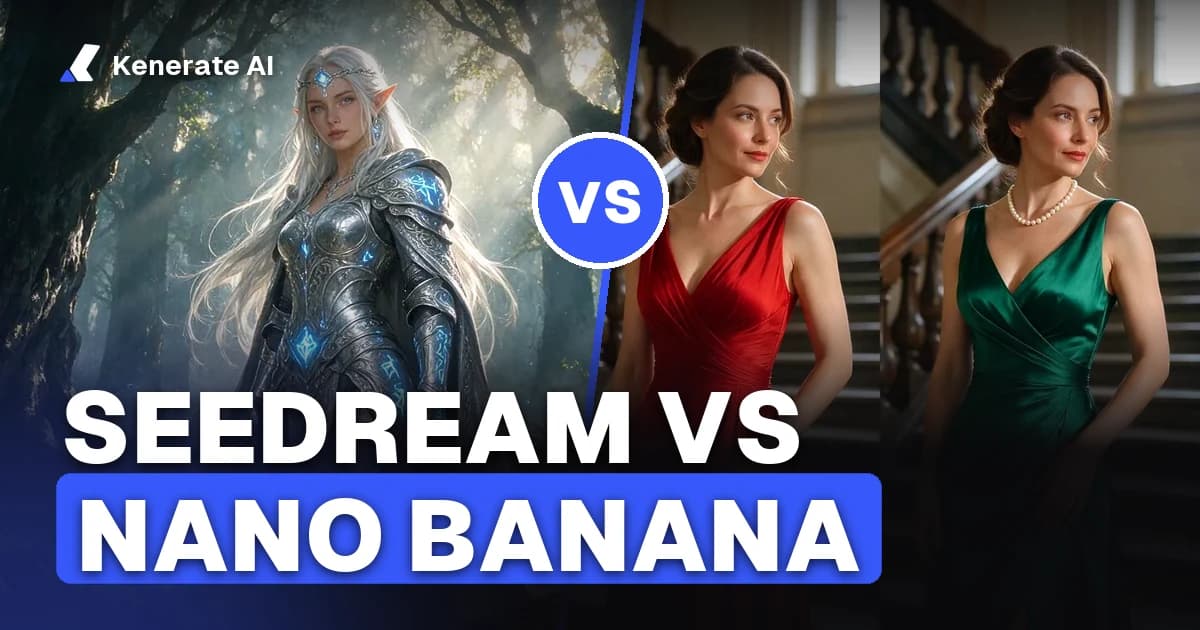
Seedream 5.0 Pro and Nano Banana 2.1 are the two flagship "do almost anything" image models of 2026, from ByteDance and Google. Seedream 5.0 Pro is the cheaper, design-minded one: ByteDance pitches it on layouts, dense multilingual text, layer separation and regional control, and on Kenerate it costs 13.5 credits per image up to 1.5K and takes up to 10 references. Nano Banana 2.1 is the editing and consistency specialist: up to 14 references, 4K output, extreme 8:1 banners and optional Google Search grounding, at 21 credits per 1K image. Choose Seedream for posters, infographics and high volume; choose Nano Banana 2.1 for product and character consistency, 4K, and anything that needs real-world facts.
This comparison uses ByteDance's and Google's own documentation plus Kenerate's model config, all checked on 23 October 2026. We have not run a scored test of our own, so you will find specs, prices and documented features here rather than a declared winner.
What is the difference between Seedream and Nano Banana?
Seedream is ByteDance's image model family, made by its Seed team. Seedream 5.0 Pro, launched on 8 July 2026, is the current flagship. ByteDance's launch post frames it as a model that "understands design": it turns data and dense text into infographic layouts, renders text in more than ten languages (including right-to-left Arabic), splits a poster into separate editable layers, edits by point, lasso or sketch, and generates inside regions you outline with coloured frames. A cheaper Seedream 5.0 Flash and a 5.0 Lite sit below it.
Nano Banana is the nickname for Google's Gemini image models. Nano Banana 2.1 (gemini-nano-banana-2.1) is Google's current high-efficiency model, an update to Nano Banana 2. Google's model page lists improved visual quality, multi-turn character consistency, accurate text rendering and grounding with Google Web and Image Search, at 1K, 2K and 4K, with minimal, medium and high thinking levels.
In short: Seedream leans into graphic design and fine-grained editing controls; Nano Banana leans into conversational editing, reference fidelity and world knowledge.
Seedream 5.0 Pro vs Nano Banana 2.1 on Kenerate: side by side
Values in the Kenerate rows come straight from the app's image model config and credit calculator on 23 October 2026.
| Seedream 5.0 Pro | Nano Banana 2.1 | |
|---|---|---|
| Maker | ByteDance (Seed) | |
| Released | 8 Jul 2026 | Oct 2026 (update to Nano Banana 2) |
| Credits on Kenerate | 13.5 at 1K or 1.5K, 27 at 2K | 21 at 1K, 31.5 at 2K, 42 at 4K |
| Resolution tiers on Kenerate | 1K, 1.5K, 2K | 1K, 2K, 4K |
| Aspect ratios on Kenerate | 15, including 1:3, 3:1, 9:21 and 21:9 | 14, including 1:4, 4:1, 1:8 and 8:1 |
| Reference images | Up to 10 | Up to 14 (4 characters + 10 objects) |
| Web search grounding | No | Optional (+4.2 credits on Kenerate) |
| Thinking levels | Not documented | Minimal, medium, high on Google's API (not a setting on Kenerate) |
| Output format on Kenerate | PNG or JPEG | Model default |
| Vendor-documented strengths | Layout, multilingual dense text, layers, regional control | Edits, consistency, text, search grounding |
| AI watermark | Not covered in ByteDance's launch post | SynthID on every image |
Seedream 5.0 Pro's tiers top out around 2048 × 2048 pixels; fal.ai's Seedream 5.0 Pro vs Nano Banana 2 spec sheet (24 July 2026) also lists "up to 10" references and a 1024 to 2048 pixel range. Nano Banana 2.1 goes to 4K (4096 × 4096 at 1:1).
Which is better for text, posters and infographics?
Both vendors make text a headline feature, which is unusual. The difference is emphasis:
- Seedream 5.0 Pro is pitched on design: turning data, concepts and dense paragraphs into professional layouts, adapting typography to each language's rules, and handling right-to-left script and accents. Its regional control lets you mark where each element goes by drawing coloured boxes on a reference.
- Nano Banana 2.1 lists "accurate text rendering" and better infographic layout among its improvements over Nano Banana 2, and its Google Search grounding can pull real facts (a current chart, a real landmark) into the image.
Practical rule: for multi-language posters, menus and data-heavy infographics on a budget, start with Seedream 5.0 Pro. For text that must be factually current, or graphics that also need 4K or an 8:1 banner shape, start with Nano Banana 2.1. Either way, put the exact words in quotes in your prompt and say where they go.
Which is better for editing and consistent characters?
Nano Banana 2.1 has the higher documented reference limit: up to 14 images, which Google splits into up to 4 characters and up to 10 objects. It was built for multi-turn editing, so you can change a jacket, then the background, then the light, and the person stays the same. Google lists multi-turn character consistency as one of 2.1's specific improvements.
Seedream 5.0 Pro takes up to 10 references on Kenerate. ByteDance highlights precise, local edits: point and lasso selection, sketch-guided changes, colour and material swaps, and fusing several images into one. If your edit is "change just this region" or "recolour this material," Seedream's documented tools are aimed squarely at that.
| Editing job | Start with | Why |
|---|---|---|
| Same face across a series | Nano Banana 2.1 | Up to 4 consistent characters, multi-turn edits |
| A product line in one scene | Nano Banana 2.1 | Up to 10 object references |
| Swap a material or colour in one area | Seedream 5.0 Pro | Region and material edits are a documented focus |
| Combine several photos into one design | Either | Seedream: multi-image fusion; Nano Banana: 14 references |
How much do Seedream and Nano Banana cost?
On Kenerate (credits per image, from the model config on 23 October 2026):
| Model | 1K | 1.5K | 2K | 4K |
|---|---|---|---|---|
| Seedream 5.0 Pro | 13.5 | 13.5 | 27 | — |
| Seedream 5.0 Flash | 8.1 | 8.1 | 8.1 | — |
| Seedream 5.0 Lite | — | — | 10.5 | 10.5 |
| Nano Banana 2.1 | 21 | — | 31.5 | 42 |
| Nano Banana 2 Fast | from 8 | — | — | — |
Nano Banana 2.1 adds 4.2 credits when web search is on. At 1K, Seedream 5.0 Pro costs about 36% less than Nano Banana 2.1 per image (13.5 vs 21 credits); at 2K the gap narrows to 27 vs 31.5. Both models need a paid credit pack on Kenerate; the free plan covers a separate set of free image models.
Through the vendors' APIs, Google's Gemini API pricing lists Nano Banana 2.1 at $0.0336 (1K), $0.0504 (2K) and $0.113 (4K) per image on the standard tier, with no free tier for image output. ByteDance sells Seedream through BytePlus ModelArk; resellers' prices vary, and fal.ai listed Seedream 5.0 Pro at $0.0675 per image up to 1536 × 1536 and $0.135 above that on 24 July 2026.
Seedream or Nano Banana: which should you pick?
| Your job | Pick | Why |
|---|---|---|
| Posters, menus, infographics in several languages | Seedream 5.0 Pro | Layout and multilingual text are its pitch; cheaper per image |
| High-volume illustration or anime drafts | Seedream 5.0 Flash or Pro | 8.1 to 13.5 credits per image |
| Product shots that must match the real product | Nano Banana 2.1 | Up to 10 object references, literal edits |
| The same character across a campaign | Nano Banana 2.1 | 4 consistent characters, multi-turn editing |
| Print-size or 4K output | Nano Banana 2.1 (or Seedream 5.0 Lite) | 4K tier |
| Website banners and headers | Nano Banana 2.1 | 4:1 and 8:1 ratios |
| Tall social formats like 1:3 or 9:21 | Seedream 5.0 Pro | Both ratios in its list |
| Images that need current, real-world facts | Nano Banana 2.1 | Google Search grounding |
If you are unsure, run the same prompt on both: on Kenerate that costs 34.5 credits at 1K. Keep the model that gets your brief right more often, and use the other where it is stronger.
How to compare them yourself on Kenerate
- Open Image Studio and pick Seedream 5.0 Pro.
- Write one specific prompt: subject, layout, any text in quotes, style, ratio.
- Add references if you have them, and say what each one controls.
- Generate at 1K, note the credit cost shown before you run it.
- Switch to Nano Banana 2.1, keep the same prompt and references, and generate again.
- Compare text accuracy, likeness to your references and overall look; upscale or re-run the keeper at a higher tier.
Want more on each model? See the Seedream model page and our Seedream 5.0 Pro prompt guide, the Nano Banana 2.1 page, and Nano Banana 2.1 vs Nano Banana 2. Weighing Nano Banana against OpenAI's model instead? Read GPT Image 2 vs Nano Banana.