

What is UGC? UGC stands for user-generated content: photos, videos, reviews, posts and comments made by customers, fans and other people outside a brand, rather than by the brand itself. A customer's unboxing video, a star review with a photo, or a forum post about a product are all UGC. Brands reshare it, with permission, because it shows real people using the product.
Updated 15 November 2026.
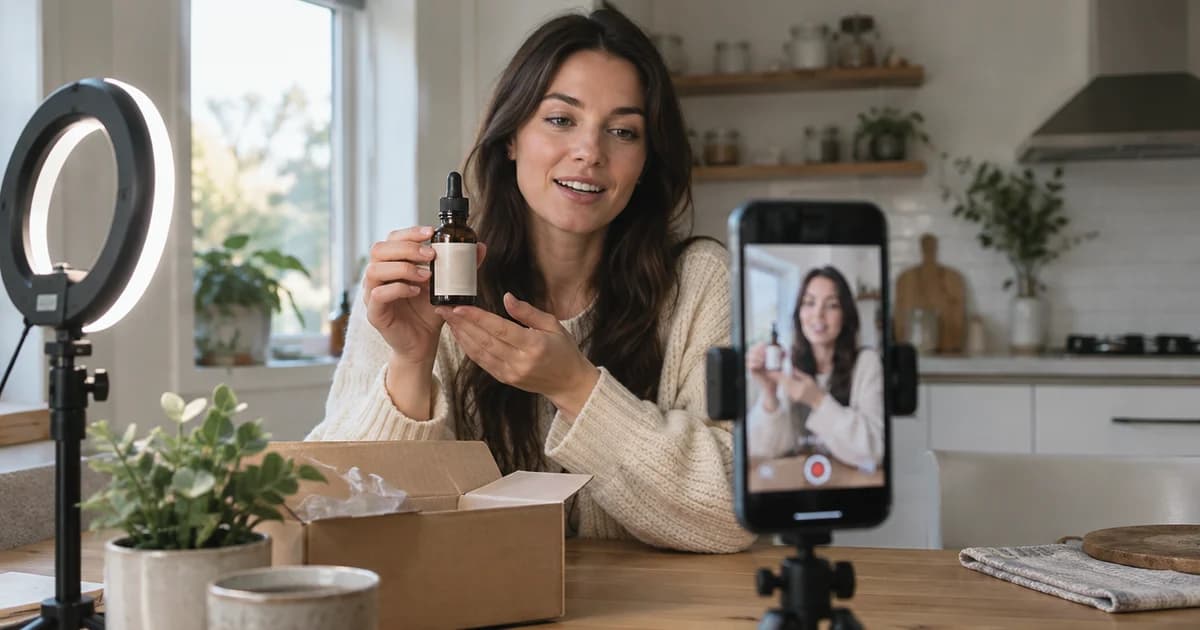
A UGC-style shoot at home: phone on a tripod, window light, the product held up to the camera. Illustration generated with GPT Image 2.5 Sunburst on Kenerate; the person is AI-generated, not a real creator.
The term has a second, newer meaning in marketing: UGC ads, or "UGC-style" content, where a brand pays a creator to film a phone video that looks like a customer's post. The people who make those videos are called UGC creators. This guide covers both meanings, how they differ from influencer content, how brands use UGC, how to become a UGC creator, and where AI fits in honestly.
UGC meaning in one table
| Term | Who makes it | Paid? | Example |
|---|---|---|---|
| Organic UGC | Real customers and fans | No | A buyer posts a photo of their new mug on Instagram and tags the shop |
| Reviews and ratings | Real customers | No (and incentivised reviews must say so) | A five-star product review with a photo |
| UGC-style ads | A UGC creator hired by the brand | Yes | A creator films a 30-second "I tried this serum for two weeks" video for the brand's TikTok ads |
| Influencer content | A creator with their own audience | Yes, or free product | A creator posts a sponsored video to their own followers |
| AI UGC | An AI-generated presenter | The brand pays for the tool | A synthetic creator holds the product and reads the brand's script |
The first two are user-generated in the strict sense. The last three are made to look like UGC, and that difference matters for honesty and for the law (more on that below).
What is UGC content, with examples
UGC content is any content about a brand that the brand did not make. Common types:
- Photos and videos on social media: outfit photos, hauls, "get ready with me" videos, unboxings.
- Reviews and ratings on a shop, Google, Amazon or a review site, often with a photo.
- Tagged posts and hashtag campaigns: a brand asks customers to post with a hashtag and picks favourites to reshare.
- Questions and answers on product pages and forums such as Reddit.
- Testimonials and case studies written or recorded by real customers.
- Creative entries: recipes, remixes, fan art, contest submissions.
How brands use UGC
- Social proof on product pages. Customer photos and reviews next to the "add to cart" button show the product in real homes, on real people.
- Reshared social posts. A brand reposts a customer's photo or video, crediting them, after asking permission.
- Paid ads. Phone-shot, talking-to-camera videos often feel less like ads in a TikTok, Reels or Shorts feed than polished studio spots. Brands either license a customer's video or hire a UGC creator to make one.
- Email and landing pages. Customer photos replace or sit beside studio shots.
- Product research. Reviews and comments tell a brand what buyers like, what confuses them and what breaks.
Ask before you reuse. A customer owns the photo or video they posted. Get written permission (many brands reply in the comments and then confirm in a DM or a short release form), credit the creator, and pay for ad usage when you put their content into paid ads.
UGC vs UGC ads vs influencer content
These three get mixed up, so here is the difference:
- UGC is unpaid and unprompted. A customer posts because they want to. It is the most trusted and the least controllable.
- UGC ads (UGC-style content) are paid. A brand hires a UGC creator to make phone-style videos that the brand posts or runs as ads. The creator's own audience size doesn't matter; the brand is buying the video, not the reach.
- Influencer content is also paid, or given free product, but it is posted to the creator's own followers. The brand is buying access to that audience.
A UGC creator is closer to a freelance video maker than to an influencer. Many UGC creators have small accounts or none at all.
What is a UGC creator?
A UGC creator is a person who makes photos and short videos for brands to use in their own channels and ads. The brand pays for the content, and usually for the right to use it, rather than for a post on the creator's account. A typical brief: film three 20–40-second vertical videos showing the product, with two or three different opening lines (hooks) the brand can test against each other.
Common UGC video formats:
- Unboxing: the parcel arrives and the creator opens it on camera.
- Review or testimonial: an honest first-person take after using the product.
- Tutorial or how-to: how to use it in two to four steps.
- Try-on: for clothes, shoes, glasses and accessories.
- Before and after: the problem, the product, the result (only when the result is real).
- Day-in-the-life: the product inside an ordinary routine.
- Voice-over b-roll: hands, close-ups and product shots with the creator talking over them.
How to become a UGC creator
- Pick two or three niches you actually use: skincare, coffee, pets, fitness, home, tech. Brands want creators who look natural with the product.
- Make three to five sample videos with products you already own. Shoot vertical (9:16) on your phone in window light, start with a strong first line, keep it under 45 seconds, and include captions. Nobody has to pay you for these.
- Build a simple portfolio: a one-page site, a shared folder or a portfolio platform, with the videos, the niches you cover and how to reach you.
- Write down your rates and what they include: number of videos, hooks, raw footage, revisions, and how long and where the brand can use the videos (organic posts only, or paid ads too). Usage rights for paid ads are usually charged on top.
- Pitch brands directly. Find brands you like that already run creator-style ads, and send a short email or DM with two sample videos and one idea for their product. UGC marketplaces and creator platforms also list briefs.
- Use a contract. It should name the deliverables, deadline, payment, usage rights and their length, and whether you may post the video yourself.
- Disclose. If you post brand content on your own account, or a brand sent you the product, say so clearly (see the FTC section below).
What you need to start: a recent phone, window light or a cheap ring light, a clip-on mic, a plain or lived-in background, and a free editing app with captions. You do not need a large following.
Where AI fits in UGC (honestly)
AI tools can now make videos that look like UGC: a synthetic presenter holds your product, talks to the phone camera and reads your script. That is useful for some jobs and wrong for others.
What AI UGC is good for
- Testing hooks and angles before you pay creators: ten opening lines in an afternoon instead of ten shoots.
- Product demos and tutorials where the product is the star and the presenter is a guide.
- Localising one ad into several languages or setups.
- Filling gaps between real creator shoots, such as a new colourway that has no customer photos yet.
What it can't do
- It isn't user-generated. Nobody bought or used the product, so an AI presenter must never be passed off as a real customer, and its lines must not be written as a personal review or results claim.
- It doesn't replace real reviews, real customer photos or a real creator's honest opinion.
On Kenerate, the AI UGC video generator runs in Marketing Studio: you pick an AI-generated creator or your own avatar, add up to nine product photos, choose a UGC style (Shopping, At home, Delivery, Review, Try-on, Unboxing, Tutorial, Before/after or Testimonial) and get a 9:16 clip. The UGC ads page shows the same tool used for TikTok, Reels and Shorts ads. Marketing Studio's instructions to the model forbid inventing star ratings, review counts, quoted reviews or customer names that aren't in your brief, and the UGC styles need a paid plan or a credit pack. Our walkthrough of AI UGC video ads and the UGC video prompts list go deeper.
UGC, disclosure and the FTC
In the US, the Federal Trade Commission's rules apply to UGC whenever money, free products or a relationship is involved:
- Creators must disclose brand relationships. The FTC's Disclosures 101 for Social Media Influencers says to disclose any financial, employment, personal or family relationship with a brand, including free or discounted products. The disclosure goes with the endorsement itself (in the video, not only in the caption or bio), in plain words such as "ad" or "sponsored", and a platform's built-in paid-partnership tool may not be enough on its own.
- Fake reviews and fake people are banned. The FTC's final rule on fake reviews and testimonials (announced 14 August 2024) prohibits reviews and testimonials that misrepresent that they are by someone who does not exist, including AI-generated fakes, or by someone with no real experience of the product.
In practice: label paid UGC and AI UGC as ads, never present an AI presenter as a customer, and only reshare real customers' posts with their permission. Rules differ outside the US, so check your country's advertising standards too. This is general information, not legal advice.
Is UGC worth it for a small brand?
Usually, yes, in this order:
- Ask for organic UGC first. Put a card in the parcel asking buyers to post and tag you, reply to every tag, and ask permission to reshare the best ones. It costs little and it is the most trusted kind.
- Collect reviews with photos on your shop and Google.
- Hire one or two UGC creators when you start running paid social ads and need several videos to test.
- Use AI UGC for drafts and tests, clearly labelled as ads, and keep real customers and real creators for anything that reads as a personal opinion.
The short version
UGC is content that customers and fans make about a brand: photos, videos, reviews and posts. "UGC ads" are paid videos made by UGC creators to look like that content, and influencer content is paid content posted to a creator's own audience. Brands use UGC for social proof, reshares and ads, with permission. To become a UGC creator, make a few sample videos with products you own, build a portfolio and pitch brands. AI can help test ideas, but an AI presenter is never a customer, and in the US the FTC requires paid relationships to be disclosed and bans fake reviews.