

The BitDance team — researchers including ByteDance and the Chinese University of Hong Kong (paper arXiv 2602.14041)
BitDance-14B
The open 14-billion-parameter autoregressive image model that predicts binary tokens instead of diffusing pixels — running in your browser. Text to image in 8 sizes up to 1536×1536, no GPU, no flash-attention setup.
- Architecture
- Decoder-only autoregressive transformer, finetuned from Qwen3-14B, with a binary tokenizer and a binary diffusion head
- Decoding
- Next-patch diffusion: 64 tokens per step on BitDance-14B-64x, 16 on BitDance-14B-16x
- Versions
- 14B-64x (1024 px, distilled from 16x for about 3× faster inference) and 14B-16x (512 and 1024 px)
- Weights
- Open under Apache 2.0; example script uses 50 steps (25 for speed) and guidance 7.5 at 1024×1024, with Python 3.11 and flash-attention
- Prompts
- English and Chinese per the model card; Gigazine's test found Japanese prompts were not understood
- On Kenerate
- kenerate/bitdance-14b — text to image in 8 sizes from 720×1280 to 1536×1536, with seed control
- Real specs
- Official sources
- Free to start
- No watermark
Updated by the Kenerate AI team
On this page
What is BitDance-14B?
What is BitDance-14B?
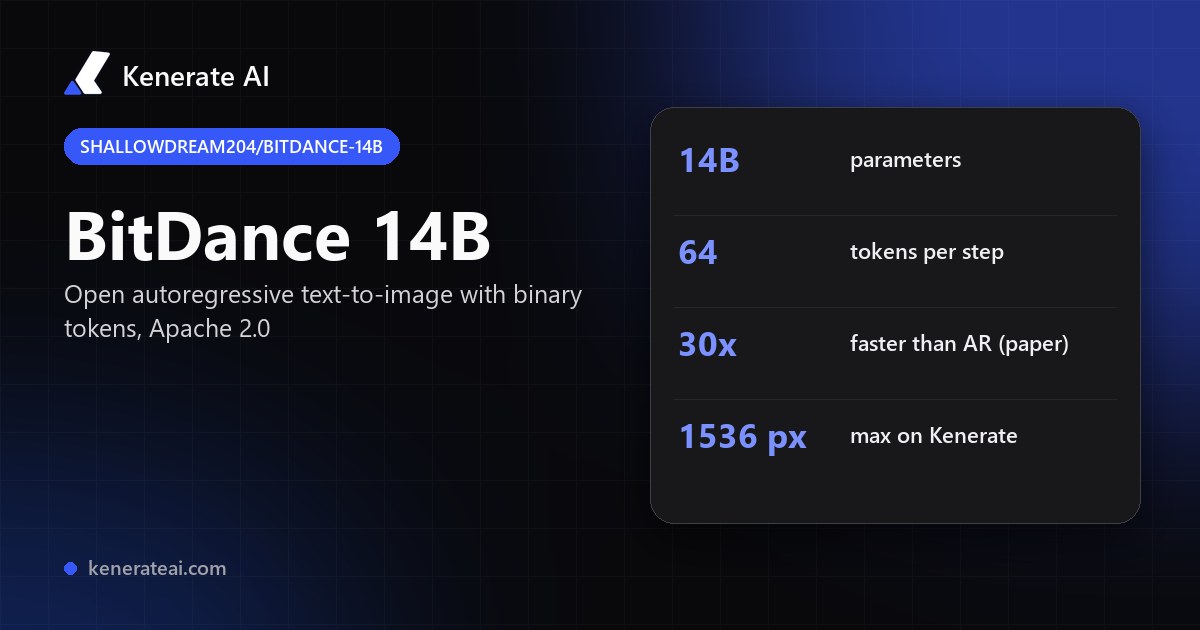
BitDance-14B is an open autoregressive text-to-image model with 14 billion parameters, built on Qwen3-14B by researchers including ByteDance and CUHK and released on 17 February 2026. Instead of diffusing a whole image, it writes the picture as binary visual tokens and predicts up to 64 tokens per step, which the paper says makes it over 30× faster than earlier autoregressive models at 1024×1024. The weights are Apache 2.0. On Kenerate AI it runs in the browser for 15 credits per image.
Key facts
- Official name
- BitDance-14B (64x and 16x)
- Hugging Face ID
- shallowdream204/BitDance-14B-64x
- Maker
- BitDance team (ByteDance, CUHK researchers)
- Released
- 17 February 2026
- Type
- Autoregressive · binary tokens
- Size
- 14B · from Qwen3-14B
- Licence
- Apache 2.0
- Inputs
- Text prompt only
- Sizes on Kenerate
- 8, up to 1536×1536
Models
BitDance-14B on Kenerate
Every version in the generator, and what each is good at.
BitDance
BitDance 14B
Baidu
ERNIE Image
Black Forest Labs
Flux 2 Klein Base 9B
- Reference images
- Up to 3
- Output
- 1536 px
Open Flux 2 Klein Base 9BBest for
Open undistilled 9B with edits
Alibaba Tongyi
Z Image Base
- Reference images
- 1 image + strength
- Output
- 2048 px
Open Z Image BaseBest for
Open 6B model, cheapest
- Free plan
Alibaba
Qwen Image 3.0
- Reference images
- Up to 3
- Output
- 1K or 2K
Open Qwen Image 3.0Best for
Free-plan option
From our tests
Strengths and limits
Good at
- A different engine from most image models: it writes the picture token by token, built on the Qwen3-14B language model.
- Fast for an autoregressive model — 64 tokens per step, over 30× faster than earlier AR models at 1024 px, per the paper.
- Apache 2.0 weights, so self-hosted copies can be used commercially; in the browser you skip the flash-attention setup.
- One flat price — 15 credits — for every size up to 1536×1536.
Limits
- No real BitDance outputs on this page yet — we only show a model's own images, so run a test prompt first.
- Text to image only on Kenerate: no reference images, edits or negative prompt.
- Not on the free plan — for free drafts use Qwen Image 3.0.
- English and Chinese prompts only; Gigazine found it did not understand Japanese.
How to
How to use BitDance-14B on Kenerate
Step 1
Open the model
Go to /app/image and pick BitDance 14B (the button on this page selects it for you). Sign in free to get started.
Step 2
Write the prompt
Describe the subject, setting, style, light and camera in plain English or Chinese sentences.
Step 3
Pick a size and seed
Choose one of 8 sizes — square 1024 or 1536, portrait, landscape, 16:9 or 9:16 — and fix the seed to compare prompt changes.
Step 4
Generate and compare
Each image costs 15 credits. Run the same prompt on another open model, such as Flux 2 Klein Base 9B or ERNIE Image, to see which suits your style.
See it in the app

Open Video Studio in Text to Video mode and write the shot — subject, action, camera move and light.


Watch the tour · 1:23
Prompts, styles, references, edit, Arena & chat
Chapters
FAQ
BitDance-14B questions
10 questions
What is BitDance?
BitDance is an open-source autoregressive image generator described in the paper “BitDance: Scaling Autoregressive Generative Models with Binary Tokens” (arXiv 2602.14041). Instead of predicting an index into a codebook, it predicts binary visual tokens using a binary diffusion head, and its next-patch diffusion decodes several tokens in parallel. The text-to-image version, BitDance-14B, has 14 billion parameters and is finetuned from Qwen3-14B.
Link to this answerBitDance vs diffusion models — what's the difference?
Diffusion models such as FLUX.2 or ERNIE-Image start from noise and refine the whole image over many steps. BitDance is autoregressive like a language model: it writes the image as a sequence of binary tokens, 16 or 64 at a time. The paper reports that this parallel decoding is over 30 times faster than earlier autoregressive models at 1024×1024. On Kenerate you can run both kinds on the same prompt.
Link to this answerIs BitDance on Hugging Face?
Yes. The weights are published by the Hugging Face user shallowdream204: BitDance-14B-64x and BitDance-14B-16x for text to image, plus the BitDance tokenizer and ImageNet research models. The code is at github.com/shallowdream204/BitDance.
Link to this answerBitDance-14B-64x vs 16x — which one?
Both are 14B text-to-image models. The 64x version predicts 64 tokens per step at 1024 px and was distilled from the 16x model for about three times faster inference with similar quality, per the GitHub README. The 16x version predicts 16 tokens per step and supports 512 and 1024 px.
Link to this answerWho made BitDance?
A research team that includes ByteDance and the Chinese University of Hong Kong, according to Gigazine's report on the release. The paper lists 11 authors, and the GitHub project says the work was accepted to NeurIPS 2026.
Link to this answerWhat licence does BitDance use?
Apache 2.0, according to the Hugging Face model card and the GitHub repo, so self-hosted copies can be used commercially under that licence's terms. Images you generate on Kenerate follow Kenerate's terms of service.
Link to this answerCan I use BitDance 14B online without a GPU?
Yes. Kenerate AI runs it in the browser as BitDance 14B, with no download, Python 3.11 or flash-attention install. Pick it in /app/image, write a prompt and choose one of 8 sizes up to 1536×1536. It costs 15 credits per image.
Link to this answerIs BitDance 14B free?
The weights are free under Apache 2.0, but you need your own CUDA GPU to run them. On Kenerate BitDance 14B is a paid model at 15 credits per image, from one-time credit packs with no subscription. New accounts get 25 credits on sign-up, and the free plan includes Qwen Image 3.0 and Flux 2 Dev.
Link to this answerCan BitDance edit images?
Not on Kenerate: BitDance 14B is text to image only, with no reference upload. To edit a picture, use an edit model such as Flux 2 Klein Base 9B (up to 3 references) or Qwen Image 3.0.
Link to this answerWhat settings does the BitDance model card use?
The example script on the Hugging Face card generates at 1024×1024 with 50 sampling steps and a guidance scale of 7.5; 25 steps is faster but may slightly reduce quality. On Kenerate those settings are handled for you — you choose the prompt, size and seed.
Link to this answerIn depth
BitDance-14B, in depth
Background, how to prompt it, and when to pick something else.
On this page
How BitDance makes an image
Most image models are diffusion models. BitDance is autoregressive: it treats the picture as a sequence, the way a language model treats text [1]. Three pieces make that practical at 14B scale [1][2]:
- Binary tokens — each image patch becomes a binary code instead of an index into a fixed codebook.
- A binary diffusion head — samples those binary tokens in continuous space instead of choosing from a softmax.
- Next-patch diffusion — predicts 16 or 64 tokens per step instead of one, the source of the 30× speed-up the paper reports.