

Nucleus AI (paper "Nucleus-Image: Sparse MoE for Image Generation", arXiv 2604.12163, 14 April 2026)
Nucleus-Image
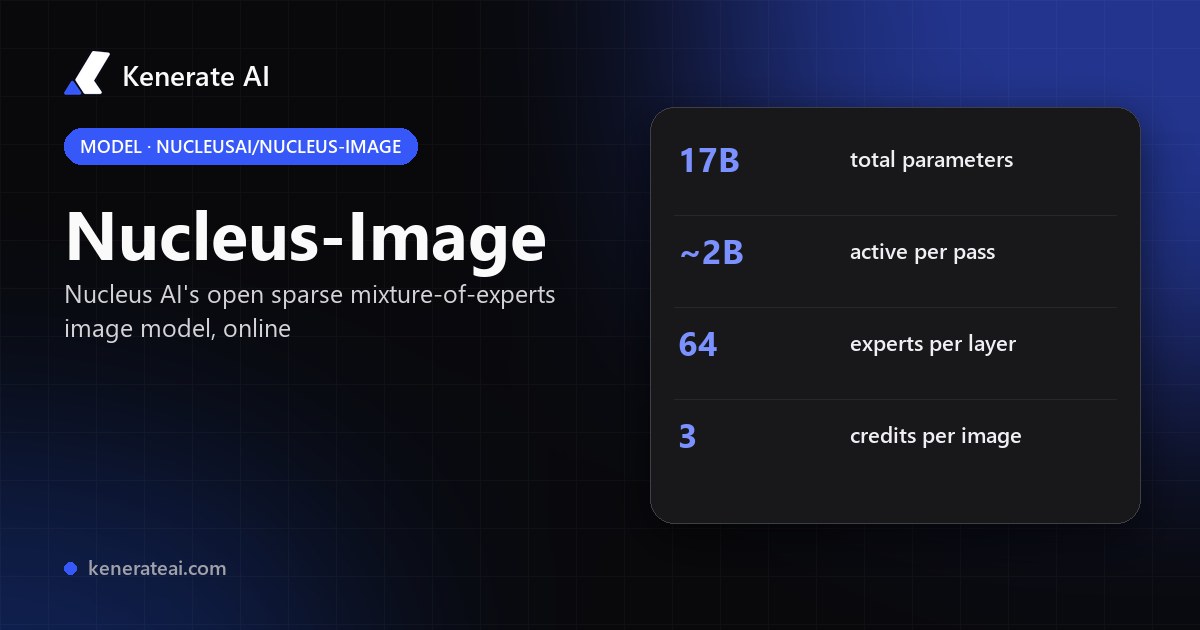
Nucleus AI's open mixture-of-experts image model in your browser: 17 billion parameters, only about 2 billion working on each step, for 3 credits an image. Negative prompt, seed and 7 aspect ratios — no GPU, no Diffusers setup.
- Architecture
- 32-layer diffusion transformer; the first 3 layers are dense, the other 29 use a mixture-of-experts layer with 64 routed experts and 1 shared expert, picked by Expert-Choice routing
- Parameters
- 17B in total, about 2B active per forward pass
- Text encoder · VAE
- Qwen3-VL-8B-Instruct reads the prompt; the Qwen-Image VAE (16 channels) decodes the picture
- Training
- 700M images and 1.5B caption pairs, resolution curriculum 256 → 512 → 1024 px, 1.7M steps, per the model card
- Native sizes
- 1024×1024, 1344×768, 768×1344, 1184×896, 896×1184, 1248×832, 832×1248
- Weights
- Open, BF16 safetensors, Apache 2.0; runs in Hugging Face Diffusers (pipeline NucleusMoE-Image) with a text KV cache
- Real specs
- Official sources
- Free to start
- No watermark
Updated by the Kenerate AI team




On this page
What is Nucleus-Image?

What is Nucleus-Image?
Nucleus-Image is an open-weight text-to-image model from Nucleus AI, released in April 2026 under Apache 2.0. It is a sparse mixture-of-experts diffusion transformer: 17B parameters in total, but only about 2B are active for each pass, chosen from 64 routed experts per layer. On Kenerate AI it runs in the browser for 3 credits per image, with a negative prompt, a seed and 7 aspect ratios.
Key facts
- Official name
- Nucleus-Image
- Hugging Face ID
- NucleusAI/Nucleus-Image
- Maker
- Nucleus AI
- Released
- April 2026 (arXiv 2604.12163)
- Size
- 17B total · ~2B active per pass
- Architecture
- Sparse MoE diffusion transformer, 64 experts
- Licence
- Apache 2.0
- Inputs
- Text prompt + negative prompt + seed
- Aspect ratios
- 7 — 1:1, 3:4, 2:3, 9:16, 4:3, 3:2, 16:9
Models
Nucleus-Image on Kenerate
Every version in the generator, and what each is good at.
Nucleus AI
Nucleus Image
- Reference images
- Text only
- Output
- 1344 px
Open Nucleus ImageBest for
This model — 17B MoE, negative prompt + seed
Alibaba Tongyi
Z Image Base
- Reference images
- 1 image + strength
- Output
- 2048 px
Open Z Image BaseBest for
Open 6B model, image remix
Alibaba
Qwen Image
- Reference images
- 1 image (edit)
- Output
- 1328 px
Open Qwen ImageBest for
Original open Qwen-Image, strong text
- Free plan
Alibaba
Qwen Image 3.0
- Reference images
- Up to 3
- Output
- Up to 2K
Open Qwen Image 3.0Best for
Text in images, free plan
Baidu
ERNIE Image Turbo
From our tests
Strengths and limits
Good at
- One of the lowest prices in the studio: 3 credits an image, so a batch of 30 prompt tests costs 90 credits.
- Negative prompt and seed, so you can remove what you don't want and re-run the exact same picture with one change.
- Nucleus AI reports GenEval 0.87 (spatial position 0.85) and DPG-Bench 88.79 for the base model — strong prompt-following for its price (vendor-reported).
- Apache 2.0 weights, training code and dataset are public, so self-hosted copies can be used commercially.
Limits
- No real Nucleus-Image outputs on this page yet — we only show a model's own images, so try a 3-credit run.
- Text to image only on Kenerate: no reference images or edits. For a remix of your own photo use Z Image Base.
- Not on the free plan — for free drafts use Qwen Image 3.0 or Flux 2 Dev.
- It is a base model: Nucleus AI says it has no DPO, RL or human-preference tuning, so style polish can trail tuned models.
How to
How to use Nucleus-Image on Kenerate
Step 1
Open the model
Go to /app/image and pick Nucleus Image (the button on this page selects it). Sign in free to get started.
Step 2
Write the prompt
Lead with the subject, then the setting, lighting, camera or art style and colours. Plain, specific sentences work better than keyword lists.
Step 3
Add a negative prompt
List what must not appear — for example "text, watermark, extra fingers, blur" — and pick one of 7 aspect ratios.
Step 4
Lock the seed
When a picture is close, keep its seed and change one word at a time; each re-run costs 3 credits.
See it in the app

Open Image Studio and type what you want to see — subject, style, lighting and mood.


Watch the tour · 1:23
Prompts, styles, references, edit, Arena & chat
Chapters
FAQ
Nucleus-Image questions
9 questions

What is Nucleus-Image?
Nucleus-Image is an open-weight text-to-image model from Nucleus AI, published on Hugging Face as NucleusAI/Nucleus-Image and described in the April 2026 paper "Nucleus-Image: Sparse MoE for Image Generation" (arXiv 2604.12163). It is a sparse mixture-of-experts diffusion transformer with 17B parameters in total and about 2B active per pass, released under Apache 2.0.
Link to this answerWhat does "sparse mixture of experts" mean for an image model?
Instead of one big feed-forward block in every layer, 29 of the model's 32 layers hold 64 smaller "expert" blocks plus one shared expert. A router sends each part of the image to a few experts, so only about 2B of the 17B parameters do work on each step. The model keeps the knowledge of a large network while each step costs closer to a small one.
Link to this answerHow much does Nucleus-Image cost on Kenerate?
3 credits per image — about $0.03 to $0.035 depending on which credit pack you buy. Credit packs are one-time purchases with no subscription. Nucleus Image is not on the free plan; Qwen Image 3.0 and Flux 2 Dev are.
Link to this answerCan I use Nucleus-Image online without a GPU?
Yes. Kenerate AI runs Nucleus Image in the browser, with no Diffusers install and no download of the 17B weights. Pick it in /app/image, write a prompt, add a negative prompt if you want, choose an aspect ratio and generate.
Link to this answerNucleus-Image vs Qwen-Image — which is better?
Nucleus AI reports a GenEval score of 0.87, which it says matches Qwen-Image, and it reuses Qwen's VAE and a Qwen3-VL text encoder. On Kenerate Nucleus Image costs 3 credits and is text to image only; Qwen Image costs 6 credits and can edit one uploaded picture, and Qwen Image 3.0 (9 credits, free plan) is the stronger pick for words inside the picture.
Link to this answerNucleus-Image vs Z-Image?
Both cost 3 credits on Kenerate. Z Image Base is Alibaba Tongyi's dense 6B model and can remix an uploaded image with a strength slider. Nucleus Image is a 17B mixture-of-experts model with a negative prompt and seed but no image input. Use Z Image for image-to-image, Nucleus for text-only prompts where you want to exclude things.
Link to this answerIs Nucleus-Image free and open source?
The weights are free under Apache 2.0, and Nucleus AI says it released the training code and dataset too. Running it yourself needs a GPU that can hold the full 17B weights in BF16 plus the 8B text encoder. On Kenerate it is a paid model at 3 credits per image.
Link to this answerHow do I run Nucleus-Image in Diffusers?
Install the latest Diffusers from GitHub, load NucleusAI/Nucleus-Image with DiffusionPipeline in bfloat16 and move it to CUDA. The model card's quick start uses 50 steps and guidance 4.0, and enabling the text KV cache speeds up sampling. The 7 native sizes run from 768×1344 to 1344×768.
Link to this answerAre the Nucleus-Image benchmark scores independent?
No. GenEval 0.87, DPG-Bench 88.79 and OneIG-Bench 0.522 come from Nucleus AI's own model card and paper, measured on the base model at 1024×1024 with 50 steps. We found no independent benchmark yet, so treat them as vendor claims and judge with your own prompts.
Link to this answerIn depth
Nucleus-Image, in depth
Background, how to prompt it, and when to pick something else.
On this page
Mixture of experts in plain words
A normal diffusion transformer runs every parameter on every step. Nucleus-Image splits most of its layers into 64 specialist blocks and lets a router choose which ones handle each part of the picture, so about 2B of its 17B parameters are busy at once [1][2]. The first 3 layers stay dense, and one shared expert in each MoE layer sees every token [1].
Two details from the paper make it cheaper still: text tokens only provide key-value pairs to the image tokens, and those are cached across denoising steps [1][3]. The result is a big model whose per-step compute is closer to a small one.
Nucleus-Image vs Qwen-Image vs Z-Image on Kenerate
All three are open-weight models you can run without a GPU here. Pick by input and job, not by headline score:
- Nucleus Image — 3 credits, text only, negative prompt + seed, 7 aspect ratios. Cheap text-to-image tests.
- Z Image Base — 3 credits, 1 uploaded image with a strength slider. Cheap image-to-image.
- Qwen Image — 6 credits, edits 1 uploaded image, strong lettering.
- Qwen Image 3.0 — 9 credits, up to 3 references, on the free plan. Best of the four for words in the picture.
Prompts that work with Nucleus-Image
The model reads prompts with an 8B vision-language encoder (Qwen3-VL-8B-Instruct) [1], so full sentences beat tag lists: "A ceramic teapot on a linen tablecloth by a rainy window, soft morning light, shallow depth of field, muted greens". Name positions explicitly ("a red bicycle to the left of a blue door") — spatial position is its best GenEval category [1]. Use the negative prompt for artefacts you keep seeing, and lock the seed once the composition is right.
By the Kenerate AI teamLast updated and reviewed
We run these models in the Kenerate generator. Model facts come from the makers' own pages; specs and limits were checked against our code; the examples are our own outputs.
Sources: NucleusAI/Nucleus-Image — Hugging Face model card · Nucleus-Image: Sparse MoE for Image Generation — arXiv 2604.12163 · NucleusMoE-Image pipeline — Hugging Face Diffusers docs · WithNucleusAI/Nucleus-Image — GitHub